MowProHQ Blog/Pricing
Production Pay vs Hourly for Lawn Care Crews
Compare hourly, piece-rate, and hybrid pay for lawn care crews, including quality controls, overtime, travel time, payroll records, and safety.

The choice between hourly and production pay affects pace, quality, recruiting, payroll, and crew trust. Neither system is automatically better. The useful question is whether the pay method fits the work and can be administered accurately.
Hourly pay is often easier for training, unpredictable properties, weather interruptions, and mixed work. Production pay—sometimes called piece-rate pay—can make output expectations clearer on stable routes. A hybrid adds an output or quality bonus to an hourly base.
This article is operational information, not legal or tax advice. Wage-and-hour rules vary by worker classification and location. Before changing compensation, have a qualified employment lawyer or payroll professional familiar with every state and locality where employees work review the written plan.
Hourly, production, and hybrid pay compared
| Method | Often fits | Main management need | Common risk |
|---|---|---|---|
| Hourly | Training, variable jobs, weather disruptions | Set pace and productivity expectations | Labor hours can drift without route review |
| Production | Repeatable services on stable routes | Define units, quality, and timekeeping | Speed can crowd out quality or safety |
| Hourly plus bonus | Teams that want a stable base and shared goals | Keep the formula simple and auditable | A complex bonus can confuse payroll and crews |
Start with the work, not the pay formula
Map a normal workweek before choosing a system:
- Clock-in and required shop preparation
- Loading, fueling, inspections, and safety meetings
- Travel from the shop to the first assignment, between assignments, and back as applicable
- Mowing, trimming, edging, blowing, and customer notes
- Dumps, equipment delays, callbacks, and weather interruptions
- Meal periods, rest breaks, training, and end-of-day work
This map reveals whether a clean per-stop unit is realistic. A route of similar weekly lawns may support production measures. First cuts, storm cleanup, landscape installation, and repair-heavy days usually need separate units or hourly treatment.
Use job checklists to define completion and a crew timeclock to capture time. Those are separate controls: a completed stop measures output, while a time record documents hours worked.
Wage-and-hour checks are part of the design
For covered, nonexempt employees in the United States, federal law generally requires at least the applicable minimum wage and overtime after 40 hours in a workweek. State or local law may set a higher minimum wage, require daily overtime, regulate piece rates, mandate paid breaks, or impose additional pay-stub and reimbursement rules. The rule most protective of the employee often controls.
Production pay also affects overtime math. Under federal rules, nondiscretionary production pay and bonuses generally enter the employee's regular rate. A simplified federal illustration is:
Straight-time earnings ÷ total hours worked = regular rate
Overtime premium = 0.5 × regular rate × overtime hours
That additional half-time formula assumes the employee has already received straight-time compensation for every hour through piece-rate earnings. It is not a universal payroll formula. Guarantees, multiple rates, bonuses, state law, and the specific plan can change the calculation, so payroll should configure and verify it.
Minimum-wage compliance must also be checked over the legally required period. Do not assume that a strong day or month cures a shortfall in a particular workweek or shorter period required by local law.
Travel, shop time, and other hours
Ordinary home-to-work commuting is generally treated differently from travel during the workday. Travel from one customer job to another is generally compensable under federal law. Required loading, cleaning, meetings, paperwork, and equipment work may also be compensable. Special one-day assignments, overnight travel, on-call time, meal periods, and employer-vehicle rules are fact-specific.
Record the time first; let a qualified local adviser determine how it must be paid. The hidden route time guide can help identify operational time that estimates often miss.
Payroll records and deductions
Keep the records required for each employee and pay period, which may include:
- Start and stop times, total daily and weekly hours, and overtime
- Production units, the rate for each unit, and how shared units were allocated
- Hourly earnings, piece-rate earnings, bonuses, additions, and deductions
- The regular-rate and overtime calculation
- Required pay-stub details and employee acknowledgments
Avoid informal deductions for recuts, broken equipment, uniforms, shortages, or customer complaints. Federal, state, and local restrictions differ, and employee authorization may not make every deduction lawful. Likewise, a quality rule that reduces or forfeits a promised bonus can raise wage-payment issues. Get local legal review before using either approach.
In MowProHQ
A practical hybrid structure
A simple hybrid can provide an hourly base plus a production or team bonus. It still needs legal review, but the operating rules can be straightforward:
- Pay employees for all compensable hours and maintain complete time records.
- Define a completed service with a short checklist.
- Give first cuts, cleanups, and add-ons separate units or keep them hourly.
- Explain how a two- or three-person crew shares credit.
- Measure quality and safe work alongside output.
- State when the bonus is earned and when it is paid.
- Recalculate overtime and minimum-wage compliance correctly each pay period.
Do not improvise a “base rate” that is expected to fall below minimum wage and then rely on a possible bonus to repair it. A payroll professional should test the actual plan against the laws that apply.
Protect quality without creating unlawful penalties
A callback is useful operational data, but it is not always proof that one employee failed. Weather, unclear scope, equipment trouble, scheduling, and customer expectations can all contribute.
Use a documented review process:
- Define objective completion standards.
- Inspect a sample of stops and coach against the same checklist.
- Categorize callbacks by cause before using them as a performance measure.
- Track repeat issues by route, property, equipment, and crew.
- Review any wage deduction or bonus adjustment with local counsel before adopting it.
The goal is to make quality visible without turning disputed customer feedback into an automatic payroll penalty.
Do not let incentives undermine safety
An incentive should never reward speeding, skipped equipment checks, missed breaks, unsafe heat practices, or underreporting injuries. Avoid “accident-free” rewards that may discourage reporting. Safer measures include completion of training, documented inspections, hazard reporting, and verified use of required procedures.
Supervisors should have authority to stop work for heat, lightning, traffic, equipment, or chemical hazards without pressuring employees to protect a production target. Review incentive plans for compliance with occupational-safety, anti-retaliation, workers' compensation, and local employment rules.
Compare the economics separately
The company's pricing target and an employee's lawful pay calculation are related business inputs, but they are not the same test.
Use these operating formulas:
Revenue per crew hour = route revenue ÷ total crew hours
Labor cost percentage = total payroll cost ÷ route revenue × 100
“Total crew hours” should include every crew member's time, not just truck time. “Total payroll cost” should include wages, overtime, employer payroll taxes, workers' compensation, and benefits used in your internal costing method.
Track these measures together:
| Measure | What it helps reveal |
|---|---|
| Revenue per crew hour | Whether route pricing supports the labor used |
| Planned versus actual hours | Estimating or routing problems |
| Callbacks by cause | Quality, scope, equipment, or training issues |
| Overtime by week | Capacity and route-balance problems |
| Safety reports and near misses | Risks that output totals do not show |
| Employee questions or pay corrections | Whether the plan is understandable and auditable |
Use the hourly rate calculator and the guide to revenue per hour for pricing analysis. Do not use a target company rate as a substitute for payroll compliance.
Pilot the plan before changing payroll
Run the proposed formula in parallel with the existing system for at least two representative pay periods without changing employee pay. Include overtime, rain, shop work, travel, first cuts, shared stops, callbacks, and equipment delays.
Then:
- Have payroll reproduce the calculation independently.
- Have local employment counsel review the plan, deductions, incentive terms, notices, and timing.
- Give employees the written formula and an example pay statement before it takes effect.
- Provide a clear way to report missing hours or production credit.
- Audit the first several payrolls and correct errors promptly.
If a crew lead, employee, and payroll processor cannot reach the same result from the written rules, simplify the plan before launch.
Using MowProHQ for the operating records
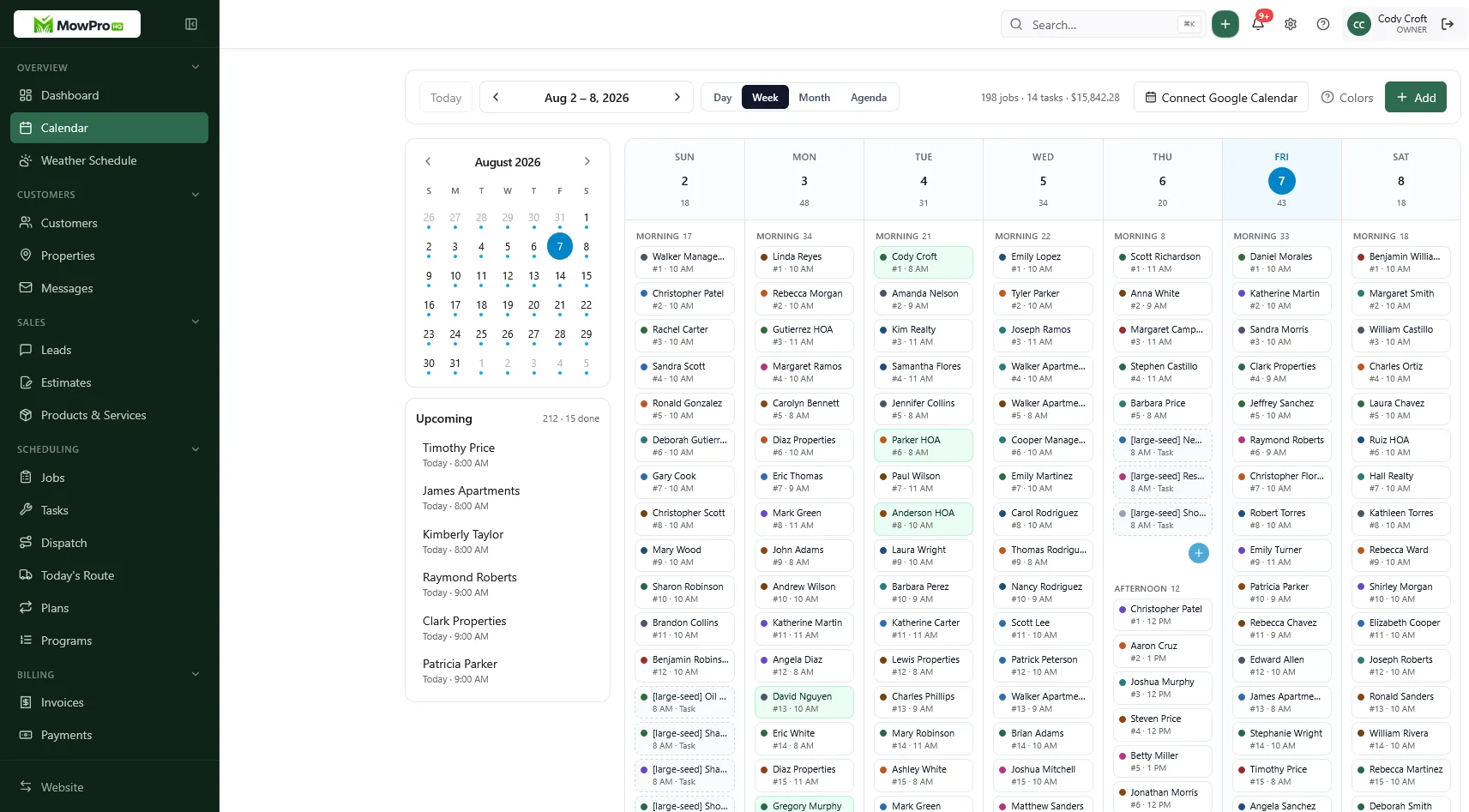
MowProHQ can keep schedules, job status, customer records, and available crew activity in one workflow. Those operating records can support payroll review, but they do not replace a compliant payroll system or local legal advice.
Review current plan details on pricing, or sign up when you are ready to organize routes and job records.
Frequently asked questions
- Should I pay lawn care crews hourly or production?
- Either can work. Hourly pay is straightforward and fits training or variable work. Production pay can connect compensation to output, but it needs accurate time records, clear quality standards, and a lawful overtime and minimum-wage calculation. Some companies use hourly pay plus a carefully designed bonus.
- What is production pay in lawn care?
- Production pay ties some earnings to measured output, such as completed stops, service units, or route revenue. The written plan should define what counts as completed, how shared work is credited, and how non-mowing work is paid.
- Is piece rate legal for lawn crews?
- Piece-rate pay may be permitted, but it does not automatically replace minimum-wage, overtime, timekeeping, pay-stub, or other employment-law duties. Federal, state, and local rules differ. Have a qualified payroll professional or employment lawyer in each jurisdiction review the plan before launch.
- How do I stop production pay from wrecking quality?
- Define completion with a short checklist, inspect a sample of work, track callbacks separately, and reward quality and safe work alongside output. Do not use deductions or bonus forfeitures without local legal review.
- Does production pay work for first cuts and add-ons?
- It can, but first cuts, cleanups, and add-ons should not be treated as ordinary maintenance stops. Define separate production units or keep variable work hourly so the plan reflects the labor involved.
- How does production pay relate to my hourly rate floor?
- The company still needs a target revenue per crew hour, while payroll must independently satisfy all wage requirements. Compare revenue, total labor hours, callbacks, and overtime rather than looking only at stop count.
- Should solo owners pay themselves production?
- Owners can use production metrics to evaluate their own work, but employee compensation is different. Once you hire, use a written plan that workers can understand and that payroll can calculate consistently.