MowProHQ Blog/Pricing
How to Price Quarterly Pest Service vs One-Off Calls
Learn how to price quarterly pest programs, initial treatments, one-time calls, travel, and interior add-ons from your actual costs.
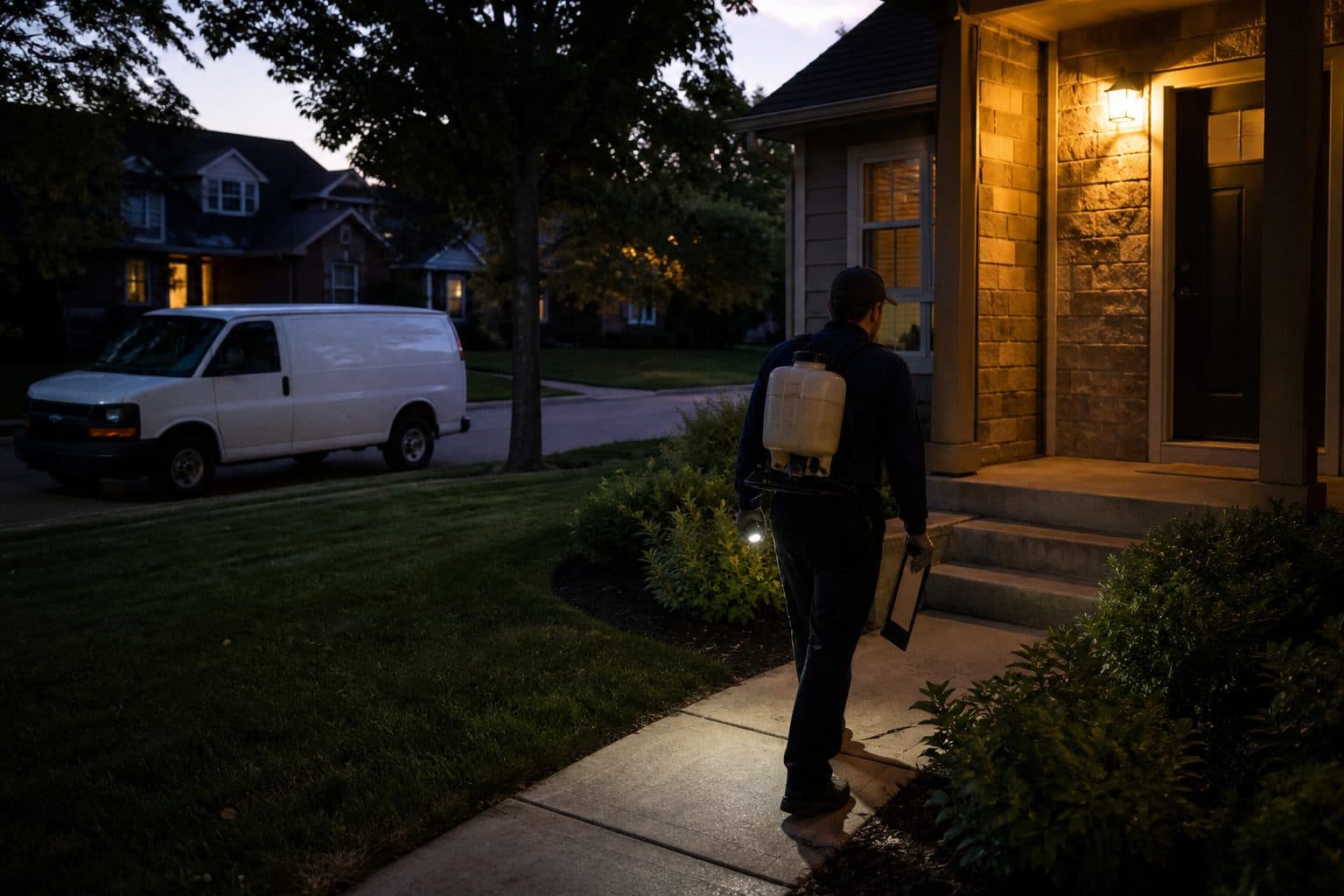
Quarterly pest programs and one-time calls have different economics. Recurring visits can be grouped into a dense route, while one-time work usually includes more uncertainty, travel, and interruption. Pricing both the same way can leave a full schedule with weak margins.
This guide explains how to build a cost floor, price the initial visit, define recurring service, and charge for travel and add-ons. Pair it with how to run recurring pest treatments so the service you sell fits the route you operate.
Know the floor before you quote the house
Build a simple cost floor before you publish a pest rate card:
- Labor (loaded hourly rate, not just wages — payroll tax, workers’ comp, overtime reality)
- Truck, fuel, and insurance slice
- Product and consumables (including what you waste on mix and leftover)
- Licensing, PPE, and a compliance-tool slice if you still file state reports elsewhere
- Overhead (phone, software, shop, marketing)
Then add the margin the business needs. Matching a lower competitor price without comparing scope and costs can create unprofitable work.
Worked example: cost floor for one tech hour
These numbers are illustrative — replace them with yours.
| Cost component | Per tech hour (example) |
|---|---|
| Loaded labor (one tech) | $32 |
| Fuel and truck | $9 |
| Product reserve | $8 |
| Overhead slice | $11 |
| Cost floor | $60/hour |
| Target margin | 35% |
| Target revenue | ~$92/hour |
If an easy quarterly exterior takes 25 minutes on site plus 10 minutes of allocated travel, you are in the ballpark of 35 minutes of economic time. At ~$92/hour, that stop wants roughly $54 before add-ons — not $39 because a competitor texted a lower number. Round up to a number customers remember, then add interior, crawl, or trip as their own lines.
You do not need perfect accounting. You need a floor you will not bid under without a strategic reason (density fill-in, off-peak, or a commercial package with volume).
Cadence changes the product
Quarterly, monthly, and one-off are not the same service at a different discount.
- Quarterly exterior: shorter visits once residual is set, tighter routes, fewer complaints if you wrote the target pests
- Monthly pressure: more time on site, more interior or hotspot work, higher product use
- One-off call: trip cost, unknown access, often interior, no residual book unless you convert it
Do not cut the quarterly rate into a “monthly special” by dividing by three. Monthly is a heavier product. One-off is an interruption product. See how to run recurring pest treatments for how those visits sit on the week.
Example packaging (illustrative)
| Package | What’s included | Pricing logic |
|---|---|---|
| Quarterly exterior | Foundation, perimeter, named pests | Lowest per visit; highest annual density |
| Monthly pressure | Exterior plus defined interior cadence | Higher per visit than a third of quarterly |
| Initial clean-out | First visit, heavier scope | Project pricing, often 1.5–2.5x a quarter |
| Same-week call-back | Named rooms or pest | Trip + time; not “included if they complain” |
Teach customers that skipping from quarterly to “just call us” changes the product. If they churn cadence mid-year, update the plan and the price — do not silently absorb interiors.
The first visit is not a cheap quarter
The initial clean-out finds the hatch, the dog, the bait map, and the German-roach surprise the photo did not show. It takes longer. It uses more product. It is how you earn the right to a 25-minute quarterly later.
Rules that keep the first visit solvent:
- Quote it as its own line, even if the customer wants “just start the program”
- Write exclusions (termites, wildlife, bed bugs, neighbor’s yard)
- Convert to quarterly only after the clean-out is invoiced
- If they decline the initial and want a cheap spray, decline or reprice — that is a one-off, not a program
Quoting from the house keeps this honest. Outline the structure. Do not let turf lot size talk you into a “medium” pest price.
Price add-ons explicitly
Interior rooms, crawlspace, attic, garage, wasp nests, and rodent stations should not be “included unless we forget.” Either:
- Bundle them into a named package, or
- List them as add-ons with prices
Ambiguity becomes a dispute on invoice day, and a callback that you cannot charge because nobody wrote the promise.
Example add-on card (illustrative)
| Add-on | Unit | Why it is not free |
|---|---|---|
| Interior, up to 3 rooms | Per visit | Time, mix, furniture, pets |
| Crawlspace or attic | Per visit | Access, PPE, extra product |
| Wasp / hornet nest | Per nest | Risk and extra setup |
| Rodent stations (install) | Per visit + device | Hardware and mapping |
| Same-week call-back outside program | Trip + time | Interruption cost |
Give technicians a clear approval and pricing process for additional work. Use the same line items from the original quote.
Trip fees and density are a pricing lever
A $89 quarterly next to five others can be profitable. The same $89 stop 25 minutes away may not be.
When a lead is outside your dense pocket:
- Charge a trip premium
- Offer a higher minimum
- Or decline politely and protect the route
Scheduling and routing help you see density. Saying no is a pricing skill. Empty miles are unpaid labor.
Density decision table
| Lead location | Default move |
|---|---|
| Inside dense Tuesday pocket | Standard program pricing |
| Edge of pocket, fills a gap | Standard or small premium |
| 20+ minutes off route | Trip fee or higher minimum |
| Opposite side of town | Decline or waitlist for a new pocket |
One-off calls: trip plus scope, not a discounted quarter
Price the one-off like this:
- Trip / minimum (covers the drive and the interruption)
- On-site time for the named area
- Product
- Explicit exclusions
- Convert offer: “Quarterly at $X after this visit”
Do not waive necessary travel charges based only on a possible future signup. Quote the current work fairly, then offer the recurring program after the initial issue is resolved.
Worked quote: medium house, quarterly vs call
These numbers are illustrative.
| Line | Quarterly program | One-off interior call |
|---|---|---|
| Economic time | 35 min | 50 min + deadhead |
| Floor at ~$92/hr | ~$54 | ~$77 + miles |
| Published visit | $95–$110 / quarter | $149–$189 plus rooms |
| Initial clean-out | $175–$250 once | n/a if they never join |
| Crawl add-on | $45–$75 | Include in the call or extra |
The specific numbers will vary, but each amount should come from documented time, travel, product use, and scope rather than a guess made at the property.
Cash vs card: decide the policy once
If you accept cards, processing has a cost. Many operators use:
- A cash/check price, and
- A Regular (card) price that covers fees
Whatever you choose, put it on the quote and invoice so nobody is surprised. A clean approach:
- Publish the cash/check package price as your base.
- Show the card total as the alternate.
- Keep the same language on recurring invoices.
- Do not negotiate the fee away job-by-job unless you are intentionally discounting margin.
Processing costs and plan terms can change, so confirm current rates before building them into your price.
Callbacks: write what the quarter includes
An unlimited callback promise can make the true scope and cost of a quarterly program unpredictable.
Write the promise:
- What target pests the quarter covers
- How many complimentary re-visits, if any, and within how many days
- What weather and sanitation conditions void the promise
- What is always billed (new pest, new area, locked hatch, pets out)
The treatment record is what makes that conversation professional. If you cannot show what you applied last visit, you will eat the callback whether it was fair or not.
When to raise, and how to say it
Raise when:
- Product or labor jumps
- You are booked out and still discounting
- A house added interior, rodent, or crawl work
- Your cost floor moved and old rates no longer clear margin
Give customers advance notice, a clear effective date, and a concise explanation. Some below-cost accounts may leave, but keeping work that consistently loses money is not sustainable.
How to communicate a raise without drama
- Lead with the visit type and what is still included.
- Give a clear effective date (often the next quarter).
- Offer package options (quarterly vs monthly) rather than only a shock.
- Update quotes, plans, and invoices together so nothing still shows the old number.
Where software helps the rate card stick
Software will not invent your rates, but it can:
- Store package prices and add-ons
- Keep quote → job → invoice aligned
- Show dual Regular vs Cash consistently
- Keep trip fees from disappearing in a text thread
That is a core reason to use pest control software instead of rewriting prices in the van. Dedicated state pesticide reporting may still sit beside it.
How MowProHQ supports pest pricing workflows
MowProHQ helps operators quote from the house, keep programs recurring on the schedule, store notes that affect service time, and carry approved pricing into invoicing. Compare current plan details when you need dispatch, route, chemical-record, or team features. Confirm state reporting requirements before replacing a dedicated compliance tool.
Price recurring service for the route you want to maintain, and price one-time work for the time and cost it actually requires.
Frequently asked questions
- How do I price quarterly pest service?
- Build a cost floor from labor, vehicle costs, products, and overhead. Estimate on-site time and related travel, add the margin your business needs, and clearly define target pests, exclusions, and any callback policy.
- Is a one-off pest call cheaper than a quarterly program?
- Usually not on a per-visit basis. A one-time call includes travel and a defined problem without the route density or recurring revenue of a program customer. Price the trip, time, product, and scope rather than discounting it in hopes of a future signup.
- Should the first pest visit cost the same as a quarterly stop?
- Usually not. The initial treatment often takes longer, uses more product, and establishes stations, access notes, or an interior treatment plan. Price it separately, then begin the recurring rate after the initial work is complete.
- How should pest companies handle trip fees?
- Use a travel charge or higher minimum when a property falls outside your normal service area. Include it on the written quote so the customer understands the total before approving service.
- What pest add-ons need their own price?
- Common add-ons include interior rooms, crawlspaces, attics, detached garages, wasp nests, rodent stations, and revisits outside the written program terms. Bundle them into a named package or list them separately.
- How do cash vs card prices work on pest quotes?
- Either include processing costs in one price or publish separate cash and card totals where permitted. Use the same policy on quotes and invoices, and confirm local rules and current processor terms.
- When should I raise quarterly pest prices?
- Review prices when labor or product costs rise, the service scope expands, or older accounts fall below your current cost floor. Give customers clear advance notice and update the recurring plan and invoices together.