MowProHQ Blog/Pricing
How to Price Interior vs Exterior Window Cleaning
Learn how to price exterior glass, interiors, screens, tracks, access, and cleaning methods as clearly defined window-cleaning services.
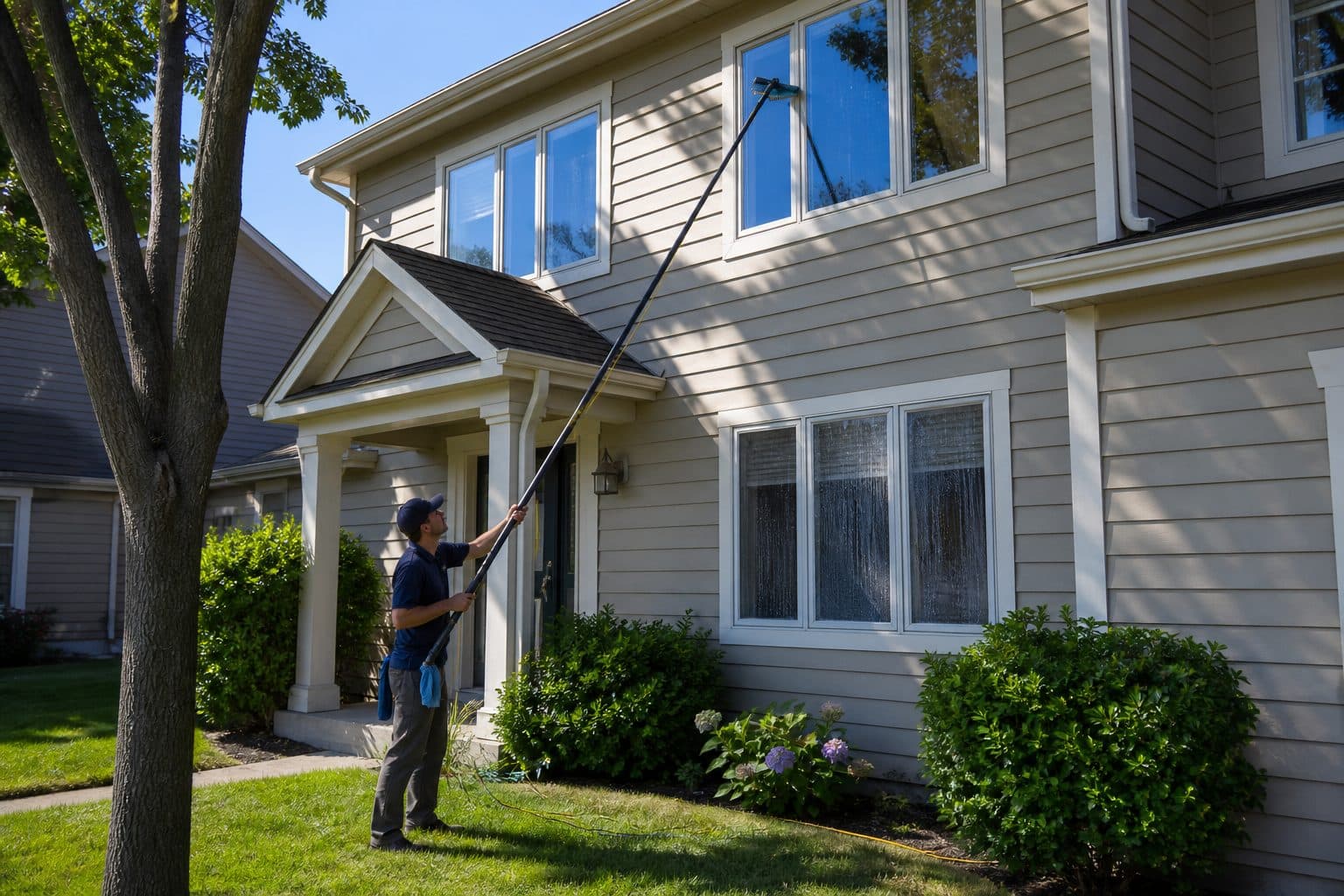
Interior and exterior window cleaning involve different time, access, equipment, and risk. A useful quote defines the glass, method, screens, tracks, height, and exceptions instead of offering one vague price for “windows.”
This guide explains how to build a cost floor, define pricing units, and create packages another estimator can apply consistently.
Know the minute before you publish a pane price
Build a cost floor the same way any route shop should: loaded labor, fuel, water and resin or chemicals, insurance, ladder and pole wear, and an overhead slice. Then add the profit you actually need — not the number that wins three texts.
You do not need perfect accounting. You need a floor you will not bid under without a reason (density fill-in, a storefront strip you already drive, or a construction clean that converts to a quarterly).
Worked example: cost floor for one tech hour
These numbers are illustrative — replace them with yours:
| Cost component | Per tech hour (example) |
|---|---|
| Loaded labor (one tech) | $32 |
| Fuel and truck | $8 |
| Water, resin, pads, blades | $6 |
| Equipment and insurance reserve | $9 |
| Overhead slice | $8 |
| Cost floor | $63/hour |
| Target margin | 30% |
| Target revenue | ~$90/hour |
If a simple exterior-only ranch is 40 minutes on site plus 10 minutes of allocated travel, you are in the ballpark of 50 minutes of economic time. At ~$90/hour, that stop wants roughly $75 before screens — not $45 because a neighbor texted a lower number.
A two-person interior on a busy two-story is a different hour. Price the crew you will send.
Pick a unit and write what it means
Customers count “windows.” You count openings, panes, or elevations. If those words stay undefined, the dispute starts when they walk the house with you at the end.
Units that hold up:
- Per pane — best on grids, French, transoms, and anything with divided lights
- Per window / per opening — fine on simple double-hungs if you say whether a double-hung is one or two
- Per elevation — useful on water-fed exteriors when the house is a simple box
- Per storefront bay or plate — commercial glass is not a residential pane card
- Per screen / per track — always separate
Pick one primary unit per product. Put a one-line definition on the quote. Two estimators in your shop should land in a tight range. If they cannot, the unit is still tribal knowledge.
Illustrative residential bands (customize to your market)
| Product | Typical unit | What it includes | What it does not |
|---|---|---|---|
| Exterior only, water-fed | Per elevation or per pane | Exterior glass, frames you can reach with the pole | Interiors, screens, tracks, skylights |
| Exterior only, traditional / ladder | Per pane | Exterior glass and sills you can reach safely | Third-story extras you did not walk |
| Interior + exterior | Per pane or per opening | Both sides, accessible rooms | Locked rooms, painted-shut sashes |
| Screens | Per screen | Remove, rinse, rehang if quoted | Repair, rescreen, bent frames |
| Tracks and sills | Per opening or house minimum | Vacuum and wipe as sold | Restoration of years of grit |
| Hard-water / mineral | Per pane or elevation | Extra dwell and agitation | A guarantee on etched glass |
A “medium house” with 40 openings and a wall of grids is not a medium price. Count.
Water-fed and ladder work are not the same visit
Water-fed exterior is often the right product on a two-story with decent hose access. It is faster per elevation. It is the wrong product when you sold interiors, when the lot has no bib, when coatings cannot take pure water, or when the west side is a ladder-only well.
Ladder and traditional work carry setup, carry, and insurance minutes you cannot wish away. Third-story, tight side yards, and occupied interiors stack those minutes.
Price the method on the quote:
| Method | Price for | Do not use the number for |
|---|---|---|
| Water-fed exterior | Reachable exterior glass on a known elevation | Interiors, screens in the garage, tracks |
| Traditional exterior | Ground-floor and ladder exteriors you walked | A water-fed speed you will not have |
| Interior | Occupied or empty rooms with access | “While we’re here” at exterior-only rates |
| Mixed method | The elevations that need each tool | One blended number with no note |
If wind kills the pole, the visit changed. Either the note already said “ladder west if windy” and the price included it, or you are doing unpaid method-switch work. Write it.
Interiors are access, furniture, and callbacks
Exterior-only is a property you can often run from the driveway. Interior work is a house you enter. That is a different risk and a different minute count.
Interiors cost more because:
- Someone has to be home, or a door code has to work
- Furniture, blinds, and sills slow the pane
- Pets and kids change the path
- A streak on the inside is a callback you drive again
- Locked rooms and painted-shut sashes become skipped panes you must document
Package interiors so the customer sees the tradeoff. Exterior-only monthly or quarterly. Interior-plus-exterior on a slower cadence. Do not silently upgrade a $75 exterior to a full interior because they “thought windows meant both sides.”
Worked quote: two-story, 36 openings
- Exterior water-fed, easy bib, both stories reachable: 70 minutes → at $1.50/minute target ≈ $105
- Interior, furniture in three rooms, code access: +55 minutes → +$85
- 28 screens, rinse and rehang: $4 each = $112, or a house screen minimum if that is your card
- Tracks on the west elevation only: $40
- Round to clean numbers: $195 exterior+interior glass, $110 screens, $40 tracks
- Scope note: exteriors water-fed; interiors all accessible rooms; north transom painted shut — excluded; skylights not included
That quote can be defended. “$250 for the house” cannot.
Screens, tracks, and the work people assume is free
Screens and tracks are where window companies bleed minutes. The glass looks done. The garage still has 20 screens in a pile. The customer thought “windows” included them.
Either:
- Bundle screens into a named package, or
- List them as add-ons with a unit and a minimum
Same for tracks and sills. Same for hard-water faces that need a different chemistry and a different promise. Etched glass does not become clear because you stayed longer. Write the limit.
Give the crew a clear approval and pricing process for work outside the accepted scope.
Storefront glass is not a residential pane card
Plate glass is bigger, faster per square foot, and meaner on the clock. You are there before open. You cannot block the door. Fingerprints come back by lunch if you sold a weekly that should have been twice a week.
Price storefronts by:
- Elevation or bay, not a house-style per-pane fantasy
- Visit cadence (weekly, twice weekly, monthly)
- Height, awnings, and bird-mess faces
- Whether door glass and side-lites are included
A cafe that needs glass twice a week is a recurring route service, not a one-time residential estimate. Put recurring commercial work on a plan with clear visit pricing and payment terms.
Use a higher minimum for a tiny office door that still requires a special trip. Volume is not density.
Construction soil is not maintenance soil
Stickers, paint overspray, plaster dust, and tape residue are a different product from a quarterly exterior. Construction cleans get project pricing, often two visits (rough and final), and a who-pays line before you unload.
Do not apply recurring maintenance rates to a punch-list property with construction debris and higher callback risk.
Cash vs card: one policy on every quote
If you accept cards, processing has a cost. Many operators publish a cash/check price and a card price. Whatever you choose, put Regular vs Cash on the quote and the invoice so nobody is surprised in the driveway.
Cash and check can stay free. Card is a priced path. Do not negotiate the fee away pane-by-pane unless you are intentionally discounting margin.
A quoting formula two people can repeat
- Count openings or panes the way your card defines them
- Choose the product: exterior-only, interior+exterior, storefront visit, construction
- Choose the method: water-fed, traditional, mixed
- Multiply by your target revenue per minute for that method
- Add screens, tracks, hard water, third-story, and trip premiums
- Round to clean numbers
- Write exclusions: skylights, painted-shut, locked rooms, etched glass
- State cadence and who pays
If two estimators produce very different prices for the same property, clarify the units, method, and adjustment rules.
Density still moves the number
A $90 exterior next to five others on a monthly pocket can be profitable. The same $90 twenty-five minutes off the route may not be. Use a trip premium, a higher minimum, or a polite no. Empty miles are unpaid labor. Far construction cleans are the usual offender.
How MowProHQ keeps the rate card on the quote
MowProHQ keeps service names, property notes, quotes, schedules, and invoices connected so exterior, interior, screens, and tracks remain clearly defined.
Compare current plans and pricing or create an account to test the window-cleaning quote workflow.
Frequently asked questions
- How do you price interior vs exterior window cleaning?
- Define interior and exterior cleaning separately. Count panes, openings, or elevations using a consistent method, list screens and tracks separately, and adjust for occupied rooms, difficult access, height, and hard-water treatment.
- Should I charge per pane or per window?
- Per-pane pricing is often clearer for divided lights, transoms, and grids. Per opening or elevation can work for simpler properties if you define the unit. Choose a consistent method and explain it on the quote.
- Is water-fed window cleaning cheaper than ladder work?
- Water-fed cleaning can be faster for reachable exterior glass, but it does not include interiors, screens, or tracks unless those are separately scoped. Price the method and services the crew will actually perform.
- How much extra should interiors cost?
- Interior work usually takes more time because of access, furniture, blinds, pets, and occupied rooms. Estimate those minutes separately or offer a clearly defined interior-and-exterior package, with screens and tracks listed according to your policy.
- How do I price window screens and tracks?
- Use a consistent unit such as per screen, per opening, or a property minimum. State whether removal, washing, reinstallation, tracks, and sills are included.
- Are storefront windows priced like houses?
- No. Storefront plate glass has different access, timing, frequency, and billing requirements. Price it by bay, elevation, or recurring visit rather than automatically applying a residential pane rate.
- Should construction window cleans use the same rate card?
- No. Stickers, paint, plaster, silicone, and tape residue make post-construction cleaning a project. Price it from the openings, soil, access, and expected visit count rather than using a maintenance rate.