MowProHQ Blog/Scheduling
How to Run Residential and Storefront Window Routes in One Book
How to schedule residential and storefront window cleaning in one system while respecting different access, timing, equipment, and billing needs.

Residential and storefront window cleaning can share one customer system, but each property needs its own access window, service method, scope, and billing details. Storefront work often happens before opening, while residential visits fit better into later neighborhood blocks.
This guide explains how to group both types of work without disrupting fixed service windows, crew assignments, or invoice requirements.
Two clocks, one customer book
A storefront stop is a before-open product. The manager wants the door glass clean when the first customer pulls the handle. A residential stop is a mid-morning product. The homeowner wants you after the dog is inside and the kids are at school.
If you schedule both as “windows on Tuesday,” you will put a retail pad at 11 a.m. and a two-story interior at 7:15. One of those visits will look unprofessional. The other will make you late for the neighborhood you already sold.
| Stop type | Typical clock | What the crew needs | What the invoice needs |
|---|---|---|---|
| Storefront / retail | Before open, or after the lunch lull | Plate-glass setup, parking that does not block the door | Net-15 or a plan, AP contact, PO if they use one |
| Office lobby | Before staff or after close | Interior access, floor protection | Billing entity, not the receptionist |
| Residential exterior | Mid-morning pocket | Water-fed or ladder, hose bib, elevation notes | Same-day pay link |
| Residential interior | Occupied-home window | Door code, pets, which rooms | Interior line, not “windows” |
Your schedule should show the constraint, not hide it under a pin. A “perfect” map that puts a bakery at noon is not a route. It is a complaint and a streak callback.
The property is the stop, not the customer name
“Chen’s Bakery” is not a stop. 14 Main Street, rear lockbox, skip the transom that was taped last month, invoice Chen Holdings net 15 — that is a stop. “The Millers” is not a stop either. 412 Oak, south hose bib, water-fed both stories, screens stacked in the garage, dog in the backyard until 9:30.
Homes, storefronts, and multi-site accounts each get a record. The customer is who pays and who you text. The property is what the tech walks up to. Mixing those two is how a helper washes the wrong elevation and a clerk gets an invoice with no address.
Put the facts the next tech needs on the property: door codes, pane notes, and skipped glass. If those live in a private chat, you do not have one book. You have a briefing job that never ends.
Fields both stop types share
| Field | Home example | Storefront example |
|---|---|---|
| Access | Side door, code 4471, close it | Rear lockbox; manager in at 6:45 |
| Clock | No work before 9 | Done by 8:00 or after 2 |
| Method | Water-fed exterior; ladder west if windy | Traditional squeegee, no pole in the aisle |
| Skipped panes | North transom painted shut | Upper transom — lift only with two people |
| Screens | Remove, rinse, rehang | None; tracks only if quoted |
| Who pays | Homeowner, same-day link | Chen Holdings, net 15, AP email |
Remove fields that do not apply, but do not substitute “see texts” for recurring access information.
Schedule distinct blocks
Route density depends on both location and sequence. A storefront strip and a nearby residential neighborhood can fit well on the same day when each remains a distinct block.
A week both crews can finish looks like this:
- Lock storefront mornings first. Those clocks do not move for a house that “is on the way.”
- Fill residential pockets the same tech can reach after 9 without crossing town.
- Park interiors on a day the home is actually open — not on the storefront dawn run.
- Assign water-fed, ladder, and interior work to the people who have the gear.
- Leave slack for rain. Exterior glass does not “just get done later” without a plan.
Routing helps when two lists run on the same day. It does not invent a clock the manager never agreed to.
In MowProHQ
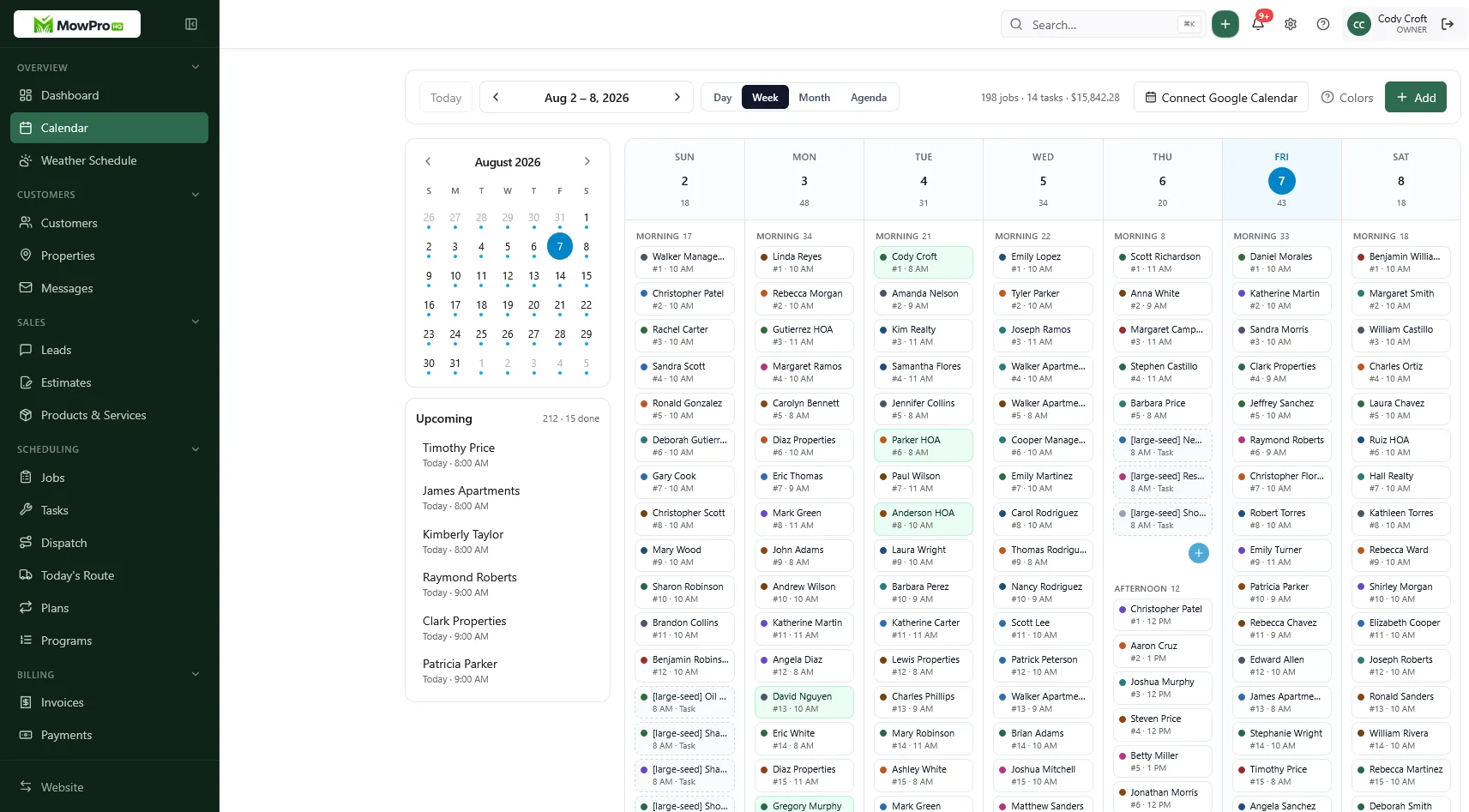
Worked week: one book, two sequences
A two-person shop has 18 storefronts on a main-street strip (weekly, before 8) and 40 homes in two neighborhoods (monthly exteriors, quarterly interiors).
Weak week: Both techs start at 7 with a mixed list. Tech A hits three houses that wanted 9 a.m., then races to a cafe that opened at 7:30. Tech B does interiors with a water-fed pole still on the roof. The office rebuilds Thursday from memory after it rains on Wednesday.
Strong week:
- Monday / Wednesday dawn: both techs on the strip until 8:15, then neighborhood A water-fed.
- Tuesday: Tech A interiors in neighborhood A (codes already on the property). Tech B storefront catch-up plus neighborhood B exteriors.
- Thursday: neighborhood B interiors and any rain makeup, storefronts first if Wednesday washed out.
- Friday: construction cleans and one-offs, not stuffed into a dawn retail run. Those are projects, not route filler.
The block schedule protects access windows and reduces unnecessary equipment changes.
Crew matching is a scheduling decision
Water-fed exterior is not a ladder interior. A tech who can run a pure-water pole on a two-story is not automatically the person you send into an occupied living room with white carpet and a cat. Storefront plate glass wants a lead who will not block the door and will not promise a free extra pane because a manager pointed at it.
| Work | Crew fit | Do not |
|---|---|---|
| Storefront dawn | Fast traditional, public-facing | Send the greenest helper alone on the busiest pad |
| Residential water-fed | Pole, hose bib, elevation notes | Force a ladder day because “it’s all windows” |
| Occupied interiors | Patient, code-ready, pane notes | Pair it with a 7 a.m. retail strip |
| Third-story / tight lot | Ladder-rated, two people if the note says so | Guess from the street and eat the hour |
Pricing interiors versus exteriors belongs on the quote. Scheduling belongs on the board. If you sold an interior and dispatched a water-fed-only morning, you sold a callback.
Invoice cadence is a dispatch fact
Residential cash flow is often same-week. Storefront cash flow is a process. Net-15, a PO, and a clerk who has never seen the glass are not “billing details you will handle Sunday.” They change whether that account can sit on a tight residential day.
If a retail pad pays net 15 and needs a line-item format AP already approved, that is a property fact. It belongs next to the lockbox, not in a folder at the shop. Invoice the storefront without paper on the counter — payment link before you leave the lot, plan billing for the accounts that actually run on a plan.
Do not add commercial terms the business cannot support. Account for the delay between service and payment when evaluating the route.
Mix when / do not mix
Mix when:
- The storefront sits inside an existing pocket
- The clock matches the first block of the day
- The truck already has the right method
- Payment terms are ones you can float
Do not mix when:
- The pad needs a special clock that splits a neighborhood
- It is 20 minutes off route “but it’s commercial”
- Interior furniture work and dawn plate glass share one tech with no reset
- One manager walk-around will eat the residential window you already sold
Far commercial leads need the same trip rule as far houses: premium, batch, or decline.
Rain, pollen, and the week that was supposed to be easy
Rain cancels exterior glass. Pollen and construction dust create callbacks that look like “you were just here.” Treat both as operations, not vibes.
Rules that keep a mixed book honest:
- Mark exterior skips with a reason. Do not invoice glass you did not touch.
- Protect storefront catch-up before the next open. A cafe that opens dirty on Friday remembers.
- Do not steal a residential pocket to save one retail pad unless you already told those homes.
- Interiors can still run if the code works and the customer is expecting you.
- After a washout, republish the week. A verbal “we’ll catch it” is how both crews drive the same street twice.
Wind changes water-fed. Freeze changes everything. The board should show the move. The property should still show the code and the skipped pane from last time.
A 15-minute Sunday publish
The week both crews can finish is the week you published while it was still daylight.
- Confirm storefront clocks with anyone who changed hours
- Confirm interior access on the homes you sold as interiors
- Assign gear: pole, ladder, interior kit
- Pull yesterday’s skipped-pane notes onto today’s jobs
- Leave one gap for rain or a construction clean that actually sold
If both technicians still depend on phone briefings, document the schedule and property records more clearly. Software for a small window crew should support the board, property, and invoice rather than only displaying a map.
How MowProHQ keeps mixed window books on one calendar
MowProHQ keeps homes and storefronts in the same property system. Scheduling holds their separate time blocks, the CRM stores access and pane notes, and quotes and invoices stay attached to the serviced property.
Compare current plans and pricing or create an account to test a mixed residential and storefront week.
Frequently asked questions
- Can I run residential and storefront window routes on the same book?
- Yes. Give every address its own access, timing, scope, and billing details. Group storefronts into before-opening routes and residential work into practical neighborhood blocks rather than alternating between the two.
- Should storefront window cleaning go on the same day as homes?
- They can share a day when they are geographically close, but they usually belong in separate time blocks. Complete storefronts during their agreed access window, then move to a nearby residential group.
- How do I schedule a mixed window cleaning week?
- Schedule fixed storefront windows first, then add residential groups the crew can finish. Match water-fed, ladder, and interior work to qualified technicians and equipment, leave room for weather changes, and publish the full week.
- What belongs on a window cleaning property record?
- Include door or lockbox codes, service windows, water-fed or ladder requirements, skipped panes, screen handling, pets, site contacts, billing contacts, and payment terms.
- Why do storefront window accounts wreck a residential afternoon?
- Storefronts often require early access, plate-glass equipment, a manager check, and commercial invoice details. Placing one in the middle of a residential sequence adds setup and travel that can delay the entire block.
- How should rain change a mixed window week?
- Mark exterior skips with a reason, reschedule storefronts within their required service window, and communicate changes before moving residential work. Interior work may continue when access and customer expectations allow it.
- Do I need two crews to mix homes and storefronts?
- Not always. One technician can complete an early storefront block and nearby homes afterward when the route is compact and the vehicle carries the right equipment. Additional staff may be needed when interiors, difficult access, and a long retail route overlap.