
MowProHQ Blog/Scheduling
How to Run a Weekly Pool Route Without a Notebook
A practical guide to weekly pool routes, including scheduling, route density, property notes, extra work, and same-day invoicing.

A dependable weekly pool route is more than a list of addresses. It combines recurring visits, a practical driving sequence, current property notes, a clear process for extra work, and accurate billing.
This guide is for operators who know how to service pools but need a route another technician can follow. It covers daily capacity, route density, property records, extra services, and invoice handoffs. If you are comparing systems, also read pool service software for a small route company.
What does a weekly pool route actually include?
Customers need to know what the recurring price covers. Define the weekly core in plain language: skim, empty baskets, brush, vacuum as needed, test, dose, and perform a visual equipment check. If green-pool recovery, filter cleaning, salt-cell service, or repairs cost extra, say so on the quote and recurring plan.
Example weekly menu (illustrative)
| Package | Cadence | Typical on-site time | What the customer hears |
|---|---|---|---|
| Weekly Core | Every 7 days | 25–40 min | Clear, balanced, equipment checked |
| Biweekly Core | Every 14 days | 40–60 min | Longer visit, more debris, higher complaint risk |
| Premium Weekly | Core + monthly tile or filter | Core + 15–25 min | Defined extras, not “whatever looks dirty” |
| Green recovery | Once | 1–3 visits | Priced like a project, not a clean |
If technicians describe the same package differently, tighten the written scope before selling more of it.
How many pools can one technician service in a day?
There is no universal stop count. Daily capacity is the sum of service time, travel, breaks, loading, and normal delays. A route concentrated in two neighborhoods can support more visits than one with long drives and unscheduled repair calls.
Rules that keep the day honest:
- Count chemical mixing and equipment glances in the visit, not in the cracks
- Put filter-clean days on the calendar as extras, not as “I’ll squeeze it”
- Treat pump and equipment calls as scheduled work instead of unplanned route interruptions
- Community gates and long walks from the street are time. Price them or group them
Worked example: one suburban Tuesday
These numbers are illustrative — replace them with yours.
| Input | Example |
|---|---|
| Target day | 8.5 hours including lunch |
| Easy weekly core | 32 minutes on site + 8 minutes allocated travel |
| Economic time per stop | ~40 minutes |
| Honest weekly capacity | 12–13 stops if nothing extra hits |
| Two salt-cell washes at 25 min each | Drops you to ~11 weeklys unless billed and sequenced |
| One unquoted pump call | Drops you to ~10 and a late last stop |
Compare the planned route with actual finish times for several weeks. If the schedule repeatedly runs late, reduce the stop count, improve the sequence, or adjust pricing for time-consuming properties. How to price weekly pool service covers the financial side of that decision.
How do you build density on a pool route?
A weekly customer near several existing stops is usually more valuable than an identical account 25 minutes away. Define a service area and use higher minimums, travel charges where appropriate, or a waitlist for distant leads. Farther accounts should contribute to a new route zone rather than remain isolated.
Day-of habits:
- Publish the sequence the night before
- Batch storm moves instead of rewriting the week stop-by-stop
- Put chemical pickup on the clock
- Store notes where the tech will see them before the gate — see pool property notes
A calendar that already has recurring due visits survives a green-pool Monday better than a stack of “we’ll fit you in.”
Density decision table
| Lead location | Default move |
|---|---|
| Inside dense Tuesday pocket | Standard weekly pricing |
| Edge of pocket, fills a gap | Standard or small premium |
| 20+ minutes off route | Trip fee or higher minimum |
| Opposite side of town | Decline or waitlist for a new day |
Declining an isolated stop can protect more profitable work already on the route.
What belongs on the property before the next tech arrives?
The property record should answer the questions a technician would otherwise ask from the driveway.
Must-haves:
- Access: community gate, side gate, pool cage latch, who to text if locked
- Parking: street, driveway, HOA tickets the circle
- Animals: dogs in the yard after school, confirm inside
- Chemical preference: salt vs chlorine, “keep it a little high,” no phosphate, kids swim at 4
- Equipment: pump brand, filter type, salt cell location, timer quirks
- Who authorizes extras vs who pays
As with lawn care property notes, keep each note short, specific, and dated. “Use south gate; dogs must be inside; keep free chlorine at 4–5 ppm” is useful. “Nice customer, picky pool” is not.
Review recurring questions from technicians and update the records that failed to answer them.
How should extras get billed on a weekly stop?
Extra work is easy to lose when it is handled at the property but not recorded there. A technician may clean a scaled salt cell or service a filter, yet the later invoice still shows only the weekly visit.
Train one close-out:
- Weekly core marked complete
- Extra named on the stop (salt cell wash, filter clean, algae shock, pump basket, tile)
- Extra billed the same day, or a quote sent from the pad if it is a repair
- Preference or equipment note updated if the extra will recur
Example extras that are not the weekly (illustrative)
| Extra | Why it is not core | Example published price |
|---|---|---|
| Salt-cell acid wash | Time + acid + future cells | $45–$75 |
| Cartridge filter clean | Soak, rinse, extra visit minutes | $65–$95 |
| DE grid clean | Mess, time, material | $120–$180 |
| Green recovery | Multiple visits, extra chem | Quote as a project |
| Pump or motor swap | Parts + diagnostic | Quote, then schedule |
Give technicians a clear process for obtaining approval and recording charges. A published extras list makes those conversations easier. See pricing weekly service and extras for a practical framework.
Equipment problems should become a quote and a scheduled repair unless there is a genuine emergency. Unplanned repair work can delay the rest of the route and create billing confusion.
When should invoices go out on a pool route?
Record the visit while its details are current. The same closeout habit that helps lawn care companies get paid faster works here: complete the stop, capture extra work, and send or queue the invoice.
A simple close-out:
- Tech marks the stop complete
- Extras checked on that job
- Invoice sent the same day, or at the fuel stop, not on Sunday
- Dual Regular vs Cash totals match the quote
- Skips marked with a reason — locked gate is not a weekly charge unless your policy says a trip fee
Waiting several days makes it easier to forget extra work or invoice a skipped stop. The full process is covered in how to invoice pool stops the same day.
If you offer different payment prices, explain them before service begins and show them consistently on quotes and invoices. Check current processing rates and applicable rules when setting that policy.
What calendar does the next tech need?
A calendar the next tech can follow has:
- Recurring weeklys already on the day, not copied from last month
- Sequence published, not “start wherever”
- Notes on the stop, not in your mouth
- Extras as line items, not tribal knowledge
- Storm and skip rules both of you obey
In MowProHQ
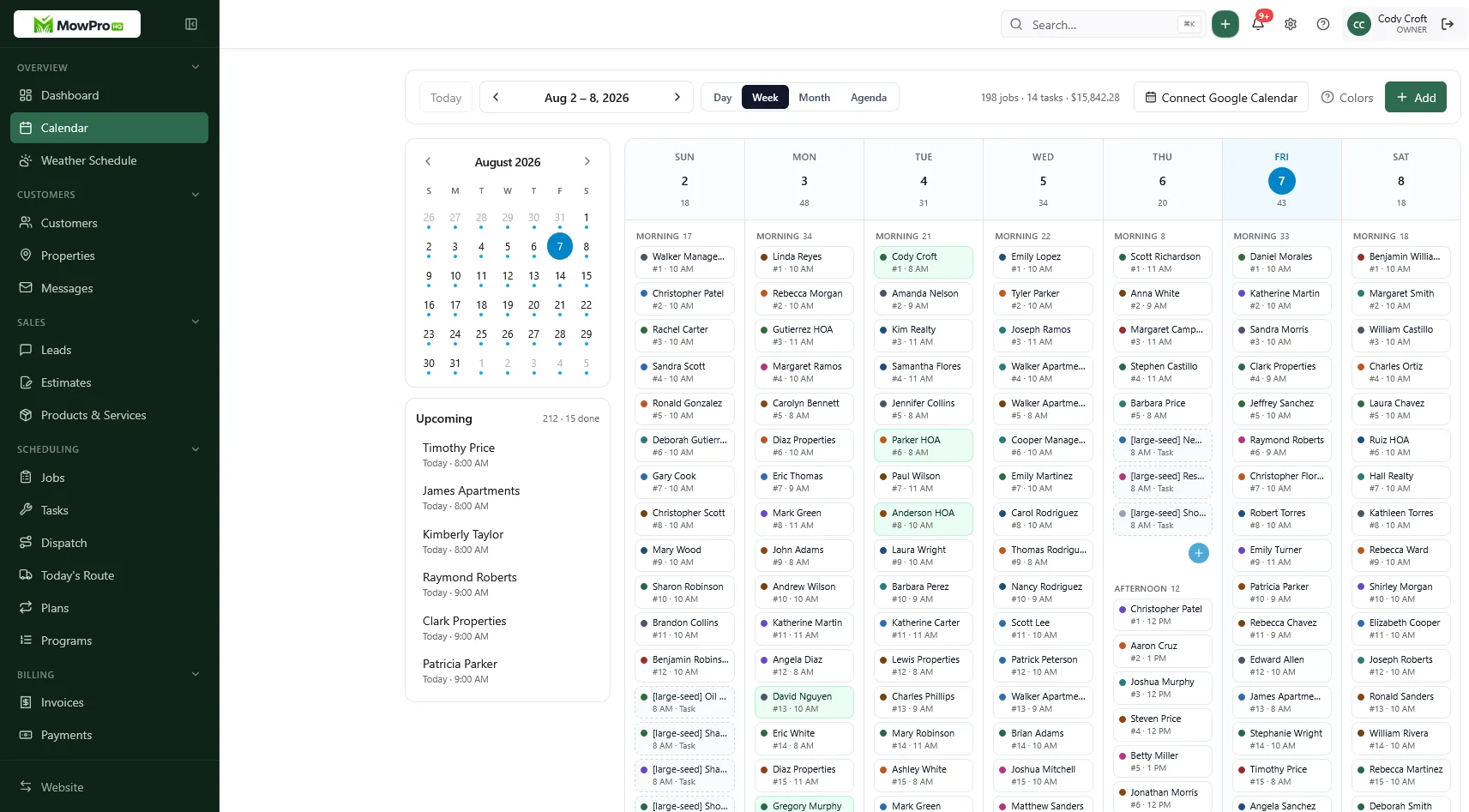
Avoid using group messages as the permanent record for route details. The current schedule and property instructions should be available to the technician in one shared system.
Quote-to-route handoff
| Step | Owner | Done when |
|---|---|---|
| Site or photo review | Estimator | Volume, equipment, access noted |
| Quote sent | Office | Customer can accept |
| Accepted | Office | Plan or job created |
| Access and chem prefs saved | Anyone who heard them | Next tech can enter |
| First visit on the board | Dispatch | Sequence visible without a text |
Complete this handoff before the first visit so the technician is not waiting for instructions on the morning of service.
Keep recurring service at the center of the route
Recurring service creates predictable route density. Recovery and equipment work can add valuable revenue, but it should not continually displace customers who expect service on a set day. Use a website and clear quotes to bring new customers into a process you control.
Mix that usually works
| Work type | Role in the week | Risk if it dominates |
|---|---|---|
| Recurring weekly | Backbone density | Low if scope stays tight |
| Recurring biweekly | Fills remaining capacity | Longer visits, more green-pool calls |
| Green recovery | Project revenue | Eats daylight if underpriced |
| Pump / equipment | High-dollar overflow | Wrecks the route if unscheduled |
When one-time work repeatedly disrupts the route, reserve a separate block for projects and repairs.
People, quality, and the second truck
Solo works until it does not. The jump is less about payroll and more about a shared board.
Before you hire:
- Weekly scope and extras are written
- Property notes exist
- Someone besides you can invoice
- The sequence is published, not narrated
When you add a helper, give them access to the current schedule and property records instead of forwarding screenshots. When a solo pool technician should add a second truck explains how to decide whether the route is ready.
Use checklists, completion notes, and appropriate photos to turn service issues into specific training. Chemical records can document what was applied, but they do not replace proper testing procedures or specialized water-analysis tools.
A 90-day operating cadence
Use this as a scoreboard.
| Window | Finish these |
|---|---|
| Days 1–14 | Three packages, radius drawn, quote template, invoice template, core extras priced |
| Days 15–45 | First dense pocket, same-day invoicing, notes on every stop, cash vs card policy published |
| Days 46–90 | Weeklys as the default offer, extras billed at the pad, far-stop policy, Friday review of time vs revenue |
Track revenue per technician hour, the share of recurring work, extras performed versus billed, and time to payment. Review pricing when labor or chemical costs change, and give customers reasonable notice before an increase.
How MowProHQ helps you run the week
MowProHQ connects scheduling, customer and property records, quotes, and invoices. Technicians can see the route and property notes while the office keeps completed work and billing attached to the same customer.
See the pool service tools, compare current plans and pricing, or create an account to test the workflow on a real week of service.
Frequently asked questions
- How do you run a weekly pool route without a notebook?
- Build recurring visits on a shared calendar, publish the next day's sequence, and keep access instructions, equipment details, and chemical preferences on each property record. Record extra work and completed visits in the field so another technician can follow the route without calling for instructions.
- How many pools can one technician service per day?
- Capacity depends on travel time, pool condition, access, and the service scope. Estimate each stop using on-site time plus related travel, then leave room for breaks and normal delays. A compact route can support more stops than a scattered route even when the pools are similar.
- What should weekly pool cleaning include?
- Define a core visit in writing. It may include skimming, emptying baskets, brushing, vacuuming as needed, testing, routine dosing, and a visual equipment check. Salt-cell cleaning, filter service, algae recovery, and equipment repairs should be listed separately unless the package explicitly includes them.
- How do I organize a pool service route by neighborhood?
- Group stops into compact neighborhood zones and keep properties with similar access requirements together when practical. A distant account should either support a new service area or be priced to cover the additional travel.
- Should pool invoices go out the same day as the stop?
- Same-day or end-of-route invoicing is usually best because the service details are still current. If you bill weekly or monthly, still record completed work and extras at each stop so nothing is lost when invoices are prepared.
- What notes does a pool tech need at each stop?
- Include gate and cage codes, parking instructions, pets, chemical preferences, pump and filter details, and the person authorized to approve extra work. Notes should be brief, current, and easy to scan before the technician enters the property.
- When should a pool company add a second truck?
- Consider a second technician when the existing route is consistently full, overtime has become routine, and additional demand is concentrated in an area you already serve. Document the schedule, service scope, and property notes before handing the route to someone else.