MowProHQ Blog/Pricing
How to Price Per-Push vs Seasonal Snow Contracts
How to price per-push and seasonal snow agreements with clear triggers, event caps, overages, extras, and service windows.

Seasonal and per-push snow agreements distribute risk differently. Seasonal customers pay for reserved capacity under defined terms, while per-push customers pay for completed events. Both need clear triggers, service windows, included surfaces, and extras.
This guide focuses on agreement structure rather than equipment or local material rates. For the decision to offer snow service, read when to add or refuse. For operations, see preparing the route before the storm.
Two products, two invoices
Customers hear “you’ll take care of us this winter.” You must hear a SKU.
| Offer | They think they bought | You must write | Invoice looks like |
|---|---|---|---|
| Seasonal / standby | You will be there every storm | Trigger, cap, extras, start window | Season fee, then overage or extras |
| Per-push | You come when it snows or they text | Response window, minimum, when you say no | One invoice per completed visit |
| “We’ll see” | A warm feeling | Nothing you can collect | April resentment |
Mixing them in a driveway sentence is the usual failure. “We’ll keep you on the list and just bill when we come” trains them to expect standby service at per-push economics, or per-push freedom at seasonal prices. Pick one. Write it. Quote it. Put Regular vs Cash on the total if they will card it.
Seasonal is not “cheaper mowing but cold.” It is availability. You are holding iron, people, and a 4 a.m. slot. That has a price even in a winter that barely shows up. Per-push is not “nice guy with a blade.” It is a visit with a trigger and a right to say no when you are already committed.
What seasonal actually buys
A seasonal contract is a retainer with rules. If you skip the rules, you sold unlimited labor for a fixed check.
Minimum language:
- Surfaces: drive only, drive plus apron, walks, lot, dock — named
- Trigger: the inch mark that starts a visit
- Start window: before 7 a.m., by 8, commercial by 6 — pick one
- Cap: how many events are inside the season price
- Overage: the per-push rate after the cap
- Ice: included, extra, or not offered
- Second pass / drift: included once, extra, or not
- Cars in the drive: abort, partial, or extra for weaving
- Term: start date, end date, what happens in a brown January
Price the cap from history, not from optimism. If your market averages six events that meet the trigger, do not write “unlimited” because it sounds premium. Write six, or eight with a fat cushion, and an overage that looks like your per-push rate.
A light winter is not a refund event unless you sold a refund. Standby was the product. They bought the slot. Say that in October so March is not a negotiation.
A heavy winter is not a volunteer event. Storm nine without an overage line is you donating sleep. Put the overage on the quote. Customers who hate it can buy per-push instead. That is a clean no.
Worked example: eight-storm winter vs three-storm winter
Same 18-drive residential book. Same truck. Season price $900. Per-push would have been $90 a visit.
Unlimited seasonal, no cap: Three-storm winter, customer feels they overpaid. Eight-storm winter, you ran eight visits for $900 — $112 a visit before ice, overtime, and the 4 a.m. payroll. You told yourself it would average out. It did not.
Seasonal with a six-event cap and $85 overage: Three-storm winter, they still paid for the slot (that was the deal). Eight-storm winter, you invoice two overages. Nobody is shocked because the quote said so.
Straight per-push at $90: Three storms, they pay $270 and you were not on the hook to sit on the phone in October. Eight storms, they pay $720 and you had the right to skip them when the book was full — if you wrote the “when we say no” rule.
Neither model is universally better. Choose the one that matches your capacity, market, and risk, then document it clearly.
What per-push actually buys
Per-push is easier to explain and easier to hide from. Hide it and you become the on-call municipal service with no retainer.
Write:
- Depth trigger (or “customer request” as a different, higher SKU)
- Minimum visit price
- Included surfaces
- Extras: ice, walks, second pass, drift refill, same-day return
- Response window: we go with the book, we do not guarantee 45 minutes
- When you will say no: already committed, outside the radius, after a cutoff hour
- How they pay: invoice after the visit, Regular vs Cash, portal link
A late request is subject to available capacity and the cutoff rules in your per-push offer. Do not imply guaranteed response when the route is already committed.
Do not let per-push customers live in the same mental slot as standby customers. On the board they can share a pocket. In the contract they cannot share a promise.
Ice, walks, salt, and other extras that bankrupt a nice number
Ice is not “a little extra on the plow.” It is material, time, and a different liability story. If you apply melt, it is a line. If you do not, the contract says you do not do ice. Selling melt you will not apply is how someone slips.
Walks are not a free helper task. They are minutes in the dark with a shovel. If the seasonal number assumed a blade on a drive, a sold walk needs a person and a price.
Salt and sand on lots are where shops invent complexity they cannot bill. You can invoice completed visits. Complex per-storm salt and material contracts may need extra setup. Until that setup is real, keep material as an explicit line you can explain, or do not sell the lot.
| Extra | Bundle only if | Otherwise |
|---|---|---|
| Ice melt | Priced and staffed | Named extra or “we do not do ice” |
| Walks / stairs | Helper is on that truck | Separate SKU |
| Second pass | Drift rule is written | Per-push add |
| Lot salt | You can measure and invoice it | Extra setup or decline |
Regular vs Cash still applies in January
If you use different payment prices, disclose them in the agreement and repeat them on the invoice. Confirm current processing costs and applicable rules.
Put the policy on the seasonal agreement and on every per-push quote. The portal is where they pay while the drift is still in the yard. Waiting until April because “snow is different” is how you donate the week. The closeout habit is in invoice snow before the thaw.
Commercial lots vs residential drives
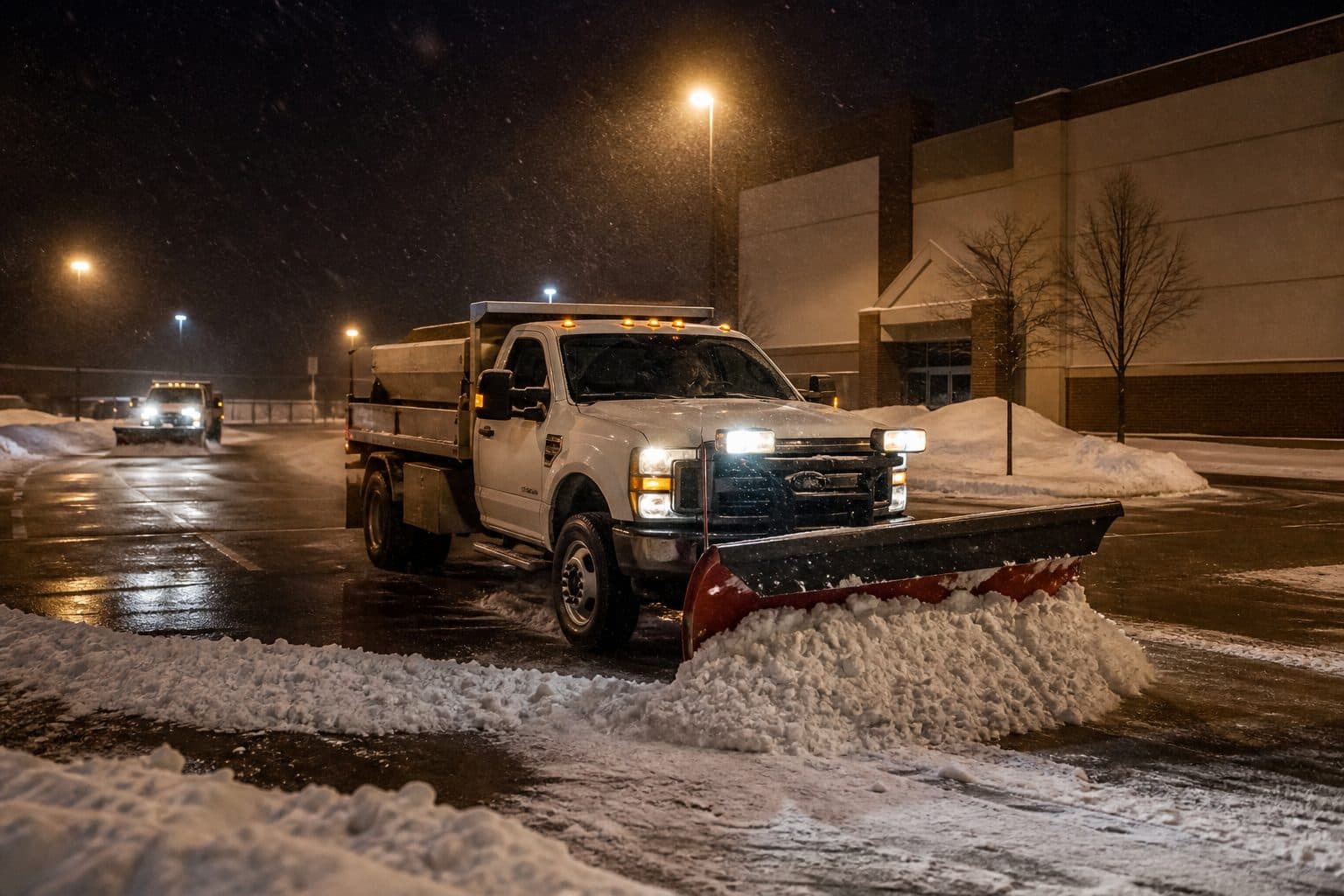
A lot is not 12 drives. It is a window, a pile plan, often material, and a customer who believes the employees should not see snow. Price the window. Price the pile relocation if you will push twice. Do not use the residential seasonal number times a gut feel.
If the lot will steal every storm from the residential book, it is not extra revenue. It is a different company. Either it is first on purpose and the drives wait (and those customers know), or the lot waits, or you refuse the lot. Changing that in the dark is how you lose both.
Residential density is the lawn-shop advantage. Price it like a pocket, not like 22 unrelated events. That is why the first-season playbook starts with the same customers you mow.
How MowProHQ holds the two products
MowProHQ supports quotes and invoices for seasonal fees with extras or individual completed visits. Properties, schedules, invoices, and customer conversations remain connected. Complex salt and material agreements may require additional setup.
Compare current plans and pricing or create an account to test both billing models before the season.
Frequently asked questions
- What is the difference between per-push and seasonal snow contracts?
- A seasonal agreement reserves service under written terms for a fixed period or price, while per-push billing charges for each completed event. They need separate triggers, service windows, extras, and invoice schedules.
- How do I price a seasonal snow contract?
- Use local event history, route costs, and the value of reserved capacity. Define the depth trigger, service window, included surfaces, event cap, overage price, ice policy, and contract term.
- How do I price per-push snow removal?
- Price each visit using the trigger, minimum charge, included surfaces, travel, and extras such as ice, walks, drift refills, or second passes. State the response window, cutoff rules, and payment terms.
- Is a seasonal snow contract cheaper per storm?
- The effective per-event price depends on the number of qualifying storms. A cap and overage rate make the risk clearer for both parties. The customer is also paying for reserved capacity, not only completed pushes.
- Should ice melt be included in the plow price?
- Only when the agreement explicitly includes and prices it. Ice treatment adds materials, labor, documentation, and risk. If you do not offer it, state that clearly.
- Can I use Regular vs Cash pricing on snow invoices?
- If you use separate cash and card prices, disclose both in the agreement and apply them consistently on invoices. Confirm local rules and current processor terms before setting the policy.
- Does MowProHQ handle per-storm salt contracts?
- Completed visits can be invoiced, but complex salt, sand, material, or event-cap agreements may require additional configuration or a specialized system. Keep material quantities and pricing explicit.