MowProHQ Blog/Quotes
Lot-Size Quoting for Lawn Care (Without Blind Guessing)
A practical method for quoting lawn care by mowable area, production time, access, slope, obstacles, and property condition.
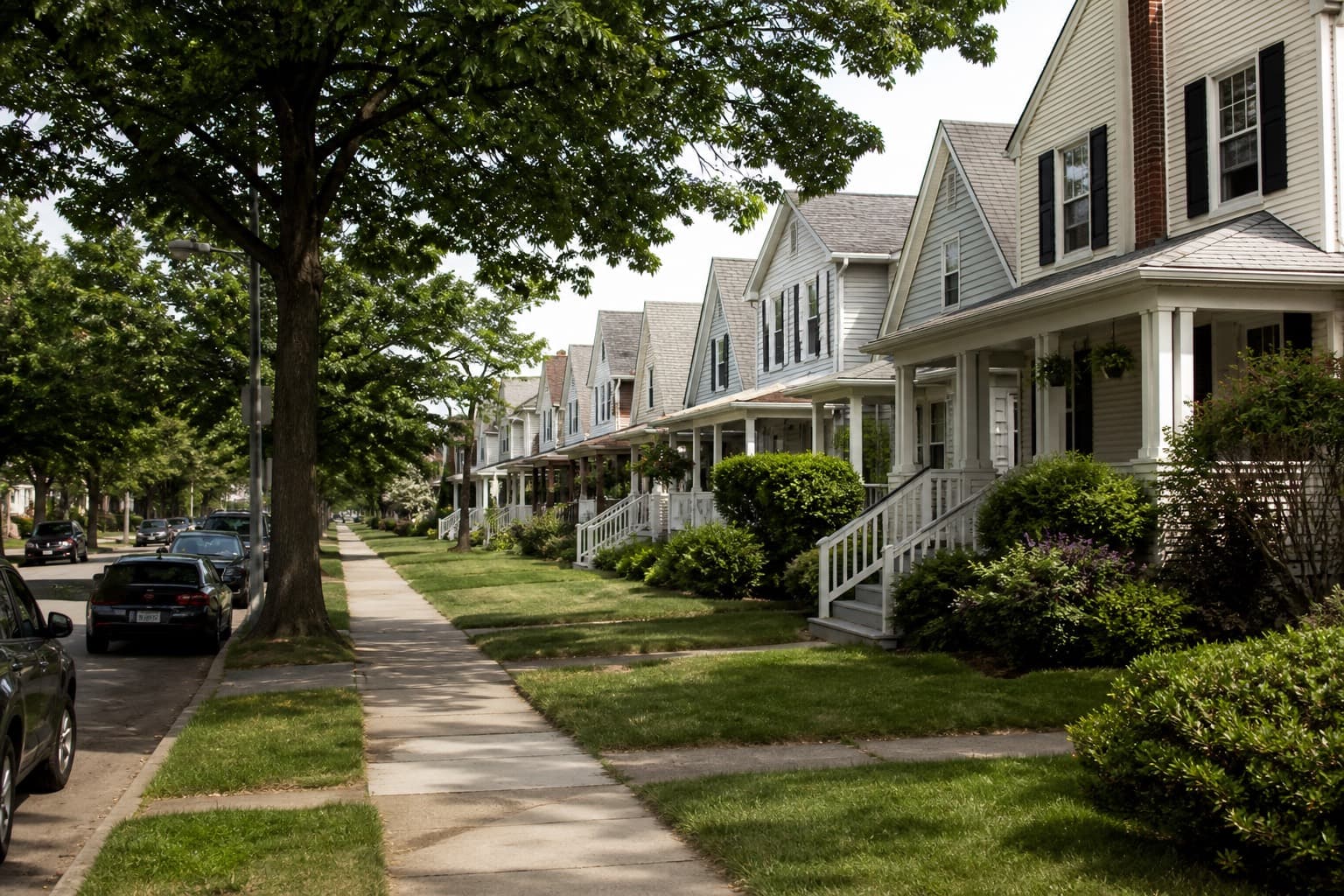
Lot size is useful for screening a mowing lead, but parcel size is not the same as mowable area. Two quarter-acre parcels can require very different amounts of crew time when one is open and flat while the other has narrow gates, trees, beds, and a steep back lawn.
The practical approach is to estimate the turf you will service, convert that area into expected production time, and adjust for conditions you can document. That gives estimators a common method without pretending a map can replace judgment.
Measure the turf you will actually cut
Start with the portions of the property included in the mowing scope. County parcel records can help locate boundaries, but they include the house, pavement, landscape beds, woods, water, and other areas the crew will not mow.
Practical measurement options:
| Method | Useful for | Main limitation |
|---|---|---|
| Aerial or satellite outline | Initial remote estimate and simple open lawns | Imagery may be old, obscured, distorted, or aligned poorly with boundaries |
| Measuring wheel | Accessible edges and irregular sections | Requires a site visit and careful treatment of curves and slopes |
| Laser or survey/property plan | Clear dimensions and defined boundaries | Line of sight, document quality, and plan age can limit usefulness |
| Prior completed-job data | Renewals and comparable nearby properties | Only useful when scope, equipment, crew, and conditions are comparable |
Map measurements are estimates, not surveyed dimensions. Tree canopy can hide turf edges, recent construction may not appear, and angled imagery can shift rooflines or fences. Do not promise a universal accuracy percentage. If a measurement could materially change the price—or if access, slope, condition, or boundaries are unclear—inspect the property before issuing a firm quote. How to write lawn care quotes covers what to confirm before the customer accepts.
Record both the estimate and its source, such as “approximately 8,200 sq ft of mowable turf, measured from aerial imagery and subject to site verification.” Update the record when landscaping, fencing, or the service area changes.
Subtract what you will not mow
Subtract areas outside the agreed scope:
- House and attached structures
- Driveways, walks, patios, and other hardscape
- Landscape beds, gardens, ponds, and wooded sections
- Locked or inaccessible enclosures
- Drainage areas or slopes that will not be serviced
- Any area excluded by the customer or by your safety policy
Do not deduct an area simply because it is difficult. Turf around many beds may reduce mowable square footage while increasing trimming time. Capture that extra work in the time estimate.

Build bands, then a base rate
Size bands can make routine estimates faster, especially when they are tied to expected visit time. Build them from your own completed jobs rather than copying another contractor’s square-foot rate. Your equipment, crew size, service definition, route density, and costs all affect the result.
Illustrative residential bands
The table below is a starting format, not a market standard. Replace the cutoffs and times with your data.
| Band | Example mowable area | Base-time approach | Review before quoting |
|---|---|---|---|
| Small | Under 5,000 sq ft | Median time for comparable easy-access stops | Minimum charge, parking, gates |
| Medium | 5,000–10,000 sq ft | Median time for comparable easy-access stops | Trimming and obstacle count |
| Large | 10,000–20,000 sq ft | Equipment-specific production time | Terrain, travel within property |
| Custom | Over 20,000 sq ft or outside normal pattern | Site-specific estimate | Equipment, staging, terrain, scope |
Use completed jobs to decide where one band should end and another should begin. If properties within a band regularly require very different times, split the band or add a clearly defined condition adjustment.
Convert expected time into a price
Set a required crew-hour revenue that covers labor burden, equipment, overhead, travel assumptions, and profit. The hourly rate calculator and guide to pricing lawn care jobs can help organize those inputs.
Use the same unit throughout the calculation:
Base service price = estimated crew-hours × required revenue per crew-hour
For example, if a visit should take a two-person crew 30 minutes, that is 0.5 crew-hours, not one labor-hour. If your model uses labor-hours instead, the same visit is 1.0 labor-hour. Choose one method, label it, and do not mix the two.
Apply your minimum visit charge where needed. Treat weekly and biweekly service as different production assumptions; longer growth, clipping volume, and seasonal conditions can change the time. See recurring mowing plans.
If you present cash and card prices, disclose them consistently and confirm that the approach complies with applicable laws and payment-network rules. See cash vs card pricing.
Adjust for conditions
Adjust the expected minutes when the actual property differs from the baseline behind your band. Estimating the extra task time is usually easier to defend than applying a multiplier without evidence.
| Condition | Estimating approach | What to document |
|---|---|---|
| Flat, open, suitable access | Use calibrated base time | Mower access and included turf |
| Trees, beds, posts, or play equipment | Add mowing and trimming time | Obstacles and trimming scope |
| Narrow gate or long equipment carry | Add setup and transport time | Gate width and access route |
| Slope | Select safe equipment and estimate slower production | Areas included, excluded, or hand-serviced |
| Soft or poorly drained ground | Allow for changed scheduling or excluded areas | Wet-ground policy |
| Overgrown first visit | Inspect and quote as cleanup work | Height, debris, disposal, and reset terms |
If you use multipliers internally, derive them from actual jobs. For example, a documented access factor of 1.25 applied to a 60-minute base produces 75 minutes:
60 minutes × 1.25 = 75 minutes
75 minutes ÷ 60 = 1.25 crew-hours
Quote basis = 1.25 × your required revenue per crew-hour
This is only valid if the original 60 minutes and the 1.25 factor reflect comparable work. Store the reason for the adjustment on the property record.
Inspect for safety, not just price
Remote imagery cannot show every hole, wire, stump, drop-off, unstable bank, pet hazard, or buried object. Before service, perform an on-site hazard check and follow the equipment manufacturer’s operating limits and your company’s safety procedures. Do not send equipment onto a slope or through an opening merely because it was included in a remote measurement. Exclude unsafe areas, choose appropriate equipment, or decline the work.
Distance is not a lot-size problem
A property can fit a standard size band and still be unprofitable because of drive time. Account for route position through your service area, minimum charge, or travel policy. Route planning should inform pricing, but travel should not be disguised as additional turf.
Hauling also adds time outside the measured lawn. Price dump runs as a separate part of the scope.
When lot size fails (and what to do)
Do not force a property into a standard band when the work is not a standard mowing visit.
Neglected yards. Inspect tall or dense growth for hidden debris and hazards. Quote the initial cut as cleanup work, including clipping handling and disposal if required. Move to recurring pricing only after the property reaches maintainable condition.
Small lawns with difficult access. A compact courtyard may take longer than a larger open lawn when equipment must be carried, unloaded remotely, or changed to fit a gate.
Obstacle-heavy properties. Playsets, lighting, exposed irrigation parts, decorative rock, and extensive bed edges can make trimming and maneuvering the main cost.
Commercial and HOA work. Parking, pedestrian controls, quiet hours, equipment restrictions, insurance requirements, and multiple service zones require a scope review. See commercial vs residential operations.
Seasonal or weather-related changes. Heavy growth, wet ground, leaves, and storm debris can change production and risk. State how rescheduling, extra work, or cleanup charges will be handled.
Exception table
| Situation | Quote type | Band? |
|---|---|---|
| Standard residential lawn with verified access | Band-based recurring quote | Usually |
| Overgrown first visit | Inspected cleanup scope | No |
| Uncertain or steep terrain | Site-specific scope and safety review | Base reference only |
| Commercial or HOA common area | Walkthrough and written specifications | Only if calibrated |
| Storm debris or hauling | Project or separate line item | No |
Teach the same method
A useful quoting system lets two trained estimators reach similar expected times from the same facts.
Minimum training kit:
- A mowable-area measurement procedure
- Band table with service definitions and base times
- Condition adjustments supported by completed jobs
- Add-on definitions for trimming, bagging, hauling, beds, and cleanup
- Minimum-charge and travel policies
- Clear rules for site inspections and safety escalation
Have estimators independently review the same completed jobs, then compare their expected times with actual crew time. Investigate consistent misses instead of choosing an arbitrary acceptable error. The cause may be a poor measurement, unclear scope, unrecorded conditions, or a band that needs recalibration.
Write the assumptions into the scope
A concise scope makes the area estimate meaningful:
Weekly mowing of approximately 7,800 sq ft of accessible turf, plus edging and blowing of hard surfaces. Area estimated from aerial imagery and subject to site verification. Landscape-bed maintenance and debris hauling are excluded. Access is through the south gate. Initial cleanup will be quoted separately if needed.
Include who handles locked gates, pets, movable objects, irrigation markings, and weather delays where relevant.
Calibrate the bands with completed work
Store enough information to compare the estimate with the outcome:
- Mowable-area estimate and measurement source
- Base time, adjustments, and total expected crew time
- Service frequency and included tasks
- Equipment and crew assumptions
- Actual start-to-finish production time
- Property changes and recurring access issues
Review a reasonable sample of normal completed visits. Separate cleanups, weather delays, equipment failures, and added work before comparing the results. Look at the median and the spread, not just the average; a few unusual jobs can distort it.
If one band consistently runs longer than expected, revise its base time, change its area boundaries, or identify the missing condition. Revisit the rate separately when labor, equipment, overhead, route density, or profit requirements change.
That is why quoting and a customer and property record work well together: the assumptions, accepted scope, and service history remain connected.
Worked example
Suppose your own records support a 60-minute base time for a property’s mowable-area band:
| Step | Calculation |
|---|---|
| Calibrated base time | 60 minutes |
| Documented access adjustment | 60 × 1.25 = 75 minutes |
| Convert to crew-hours | 75 ÷ 60 = 1.25 crew-hours |
| Base service price | 1.25 × your required revenue per crew-hour |
| Additional work | Add separately estimated time or a defined line item |
Check that the crew-hour rate uses the same crew assumption as the time estimate. Then compare the result with your minimum charge, route policy, and service-frequency assumptions. The arithmetic is simple; the quality of the quote depends on the inputs.
In MowProHQ
How MowProHQ helps lot-size quoting
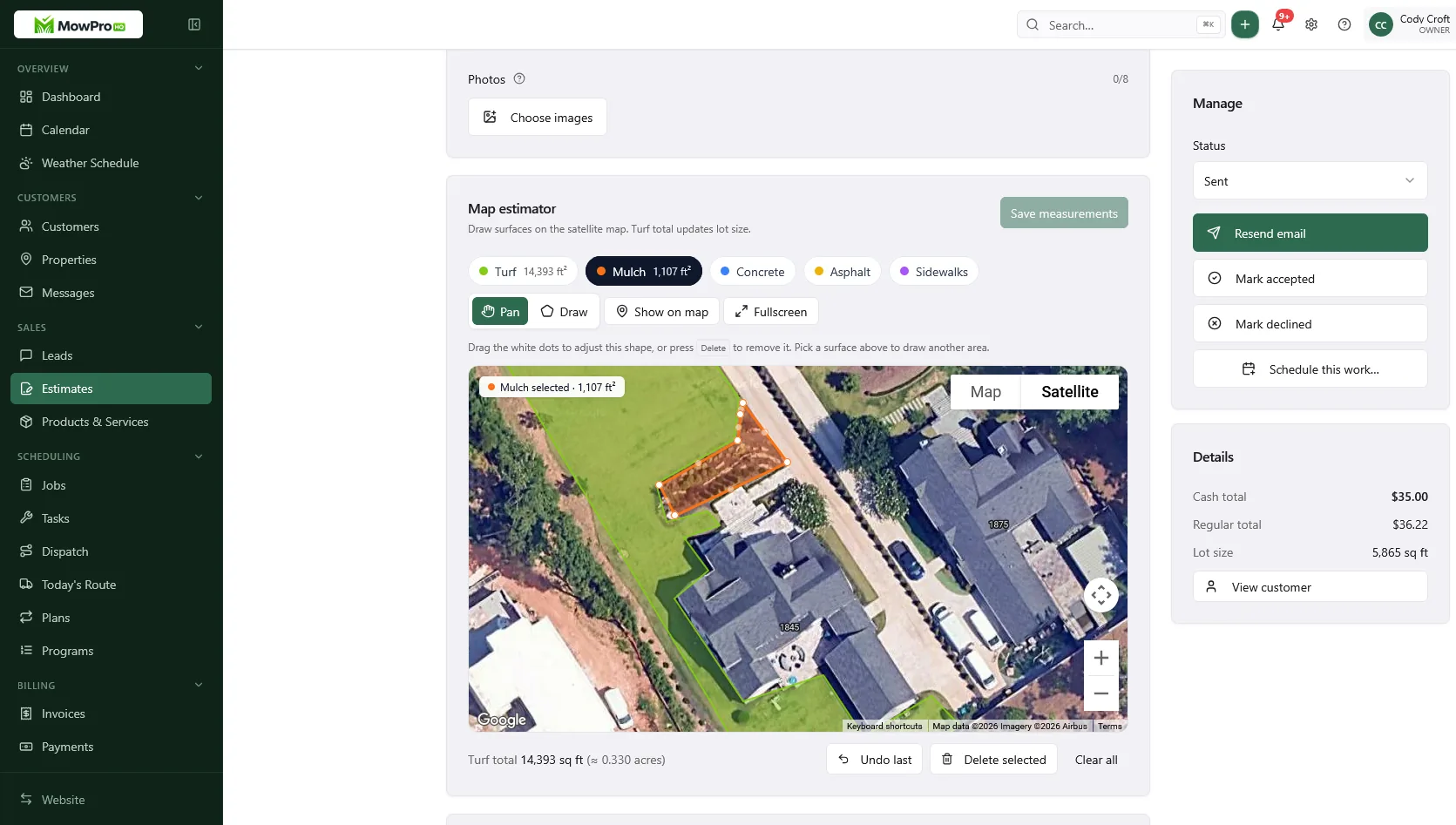
MowProHQ can keep property details, quotes, schedules, and invoices connected so the accepted scope is available to the office and crew. Use it to record the area source, access notes, service frequency, and pricing assumptions; it does not replace an on-site safety check or your own rate model.
Review current plan details on the pricing page, or sign up when you are ready to set up your workflow.
A reliable lot-size quote states what will be serviced, how the area was estimated, which conditions affected the expected time, and what still requires verification.
Frequently asked questions
- Should I quote lawn care by lot size?
- Lot size can provide a useful starting point, but the quote should be based on mowable area and expected production time. Adjust for access, slope, obstacles, turf condition, service frequency, travel, and the work included in the scope.
- How do I measure mowable square footage?
- Outline the turf on a current aerial or satellite map for an initial estimate, then verify questionable boundaries, narrow gates, slopes, and irregular areas on site. A measuring wheel, laser tool, or property plan can help. Exclude buildings, pavement, beds, water, woods, and any area you will not service.
- What lot-size bands should I use?
- Build bands from your own completed jobs. Group properties with similar mowable area and production time, establish a base time for a clearly defined standard service, and review the bands against actual crew time. The cutoffs should reflect your equipment, crew, route, and local property types.
- When does lot-size quoting fail?
- A standard band is unreliable when the property is overgrown, unsafe, difficult to access, unusually steep, crowded with obstacles, or governed by special commercial or HOA requirements. Inspect the site and quote the actual scope or a separate cleanup.
- How do I keep two estimators quoting the same number?
- Give estimators the same measurement procedure, base-time table, adjustment rules, service definitions, and minimum-charge policy. Require them to record the area source and the conditions that changed the estimate, then compare quoted time with completed-job time.
- Should lot-size quotes include cash and card prices?
- If your business offers lawful cash and card price options, disclose both clearly before acceptance and present them consistently on the quote and invoice. Check the rules that apply to your location and payment program.
- Can software store lot-size bands?
- Yes. Quoting software can store mowable area, the measurement source, service frequency, expected time, property notes, and the accepted scope. Your company still needs to set and maintain its own production assumptions and rates.