MowProHQ Blog/Marketing
Lawn Care Websites That Turn Visitors into Quote Requests
Build a lawn care website that clearly explains services and service areas, captures useful quote requests, and supports prompt follow-up.
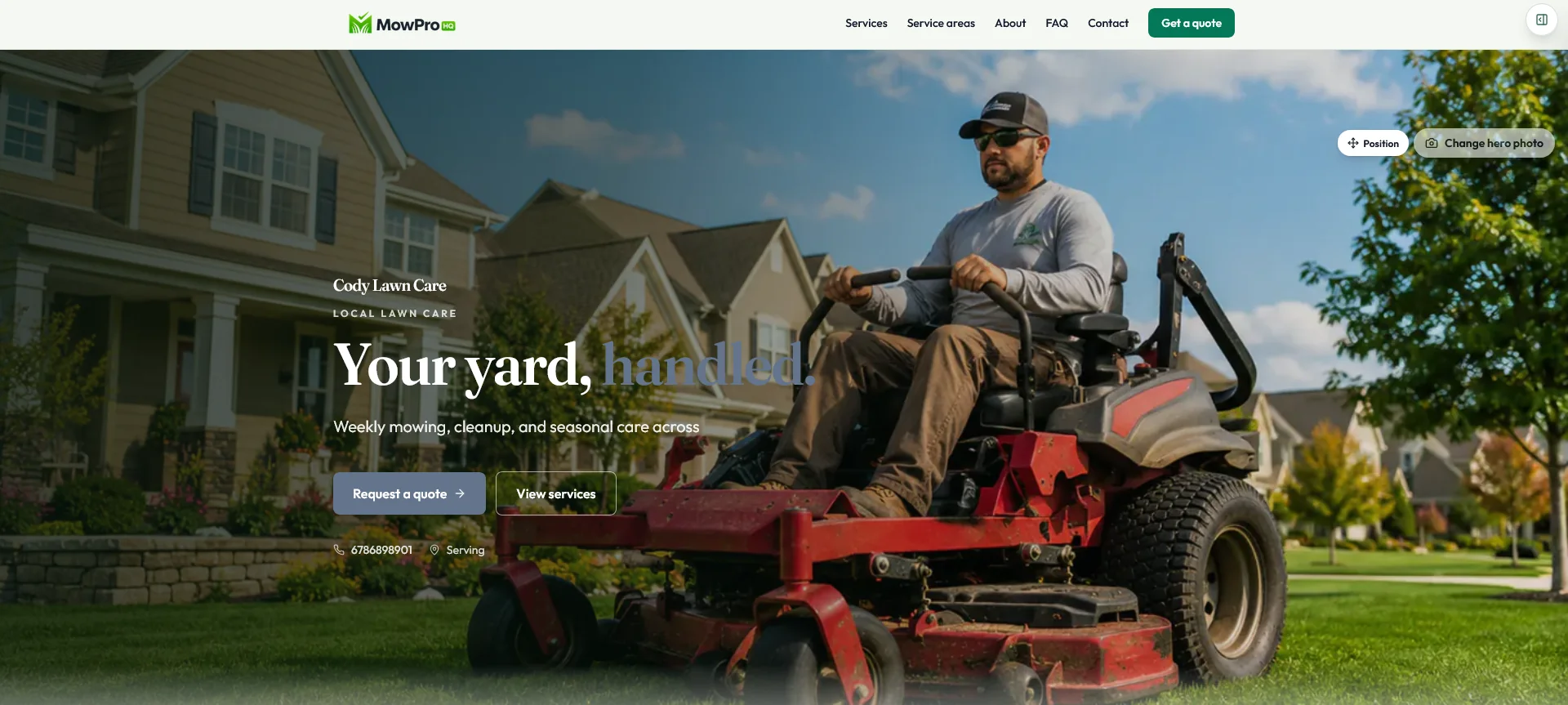
Your website should help a prospective customer understand what you offer, where you work, and how to request a quote. The lead workflow matters as much as the page: submissions need a responsible owner, a realistic response target, and a path into customer and property records.
Build pages that answer “Do you provide the service I need at my address?” Collect only useful form details, respond within the published window, and move qualified inquiries into the same system used for customers and properties.
Must-have pages and proof
Most visitors first need to confirm that the company offers the requested service, covers the property location, and provides a straightforward way to ask for a quote.
Pages that earn their keep
| Page | What it must do |
|---|---|
| Home | Identify the service, area, and primary next step |
| Services | Describe services currently offered, including scope and frequency |
| Service area | List cities, ZIP codes, or neighborhoods actually served |
| About | Give an accurate business identity and only verifiable credentials |
| Reviews / proof | Show genuine reviews and authorized project photos |
| Contact / quote | Provide the form, contact options, hours, and expected response time |
Use a consistent “Request a quote” link in predictable locations and make it accessible by keyboard and on smaller screens.
Proof that beats stock grass
Use accurate photos of work you have permission to publish. Remove customer addresses, faces, license plates, gate codes, or other identifying details unless you have appropriate authorization. Useful proof includes:
- Genuine review excerpts displayed under the platform's current terms
- A short list of property types (residential weekly, small commercial pads, HOA common areas)
- License or insurance language only if true
- A one-sentence promise you can keep (on-time window, same crew when possible, written quotes)
Do not invent testimonials, alter their meaning, or make unsupported superiority claims. Disclose material connections where required.
Service-area honesty is a lead filter
Publish the area you serve. For an address outside it, offer a waitlist or disclose the applicable travel price before acceptance. Use the same boundaries described in route planning.
Worked example: a home page that books
Unclear: “Welcome to our family-owned journey. We love green spaces. Contact us.” The visitor still does not know the service area or next step.
Specific: “Weekly and biweekly mowing in North Pensacola and Ferry Pass. Request a quote with your address; photos are optional. We respond within one business day.” Follow with the current service choices, real photos, and the form.
A short page can work when it answers the customer's main questions.
Quote forms that ask the right questions
Keep the form short enough to complete while collecting the information needed to evaluate the request.
Recommended fields
| Field | Required? | Why |
|---|---|---|
| Name | Usually | Identify the requester |
| Phone or email | Yes | Use the customer's preferred contact channel |
| Alternate contact method | Optional | Provide another way to deliver the quote |
| Property address | Yes | Lot-size quoting starts here |
| Frequency wanted | Yes | Weekly vs biweekly is a different product |
| Gate / access notes | Optional | Collect only what is needed; secure sensitive codes |
| Photos | Optional | Helps assess access, slope, obstacles, and growth |
| Preferred start | Optional | Spring rush vs “whenever” |
| How they found you | Optional | Only if you actually review the answers |
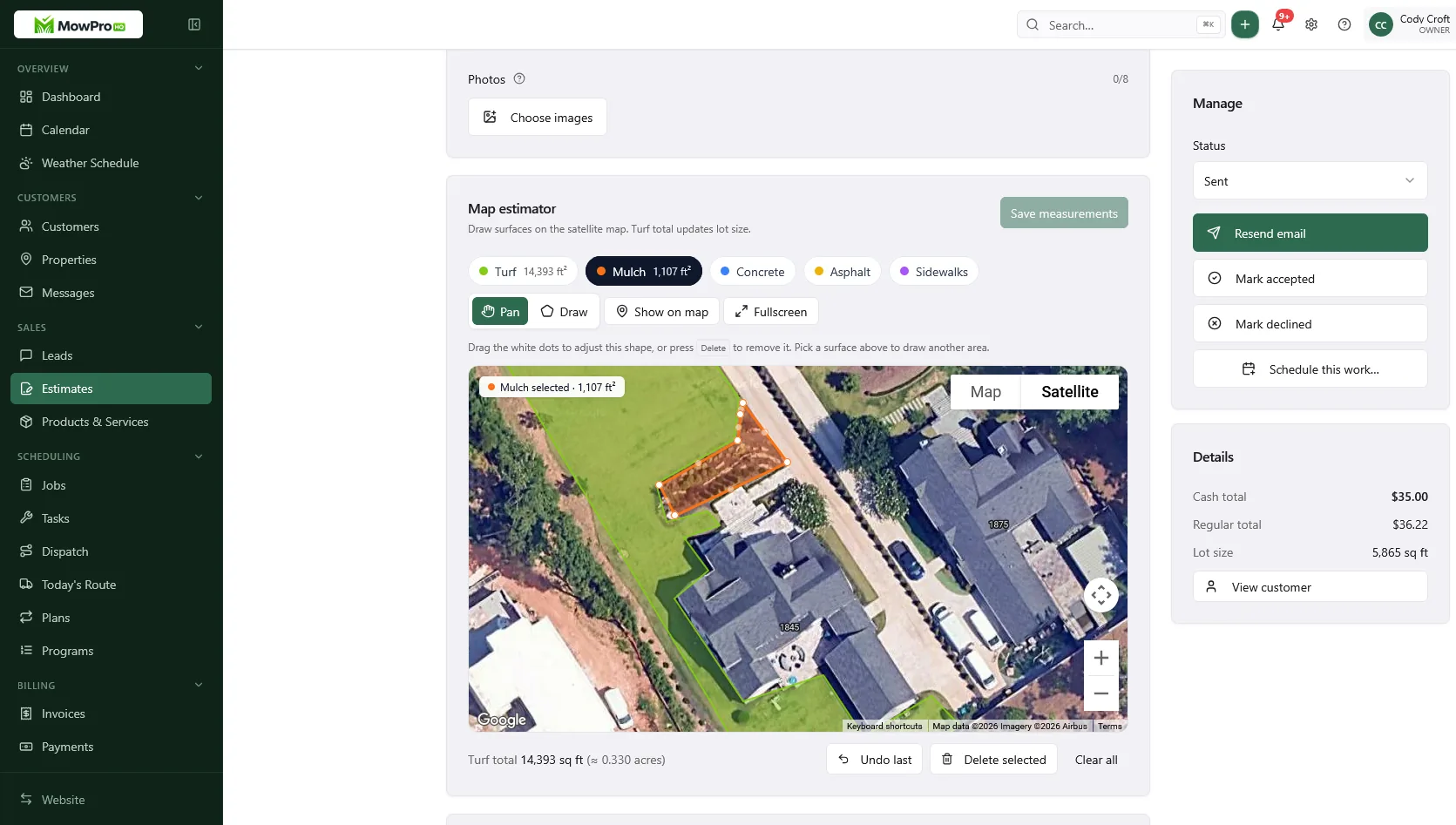
Avoid requiring technical measurements customers are unlikely to know. If you use map or aerial imagery for an estimate, verify dimensions, licensing, accuracy, and property conditions before finalizing the scope. See how to price lawn care jobs.
Form copy that improves lead quality
- Title the button “Request a quote,” not “Submit.”
- State the service area before submission.
- Give a realistic business-hours response window.
- Mention that initial cleanups are quoted separately from recurring mows.
- Link a concise privacy notice and obtain any consent required for calls, texts, or marketing.
What to do with photos
Photos can help assess access and visible conditions, but they do not replace an inspection when scope or safety is uncertain. Store uploads securely, restrict access, set a retention period, and do not reuse customer images for marketing without permission.
After they hit send
Show a confirmation with the expected response window and an alternate contact option. Send the submission to a monitored inbox, protect it from spam and abuse, and avoid exposing the form contents in URLs or insecure notifications.
Speed-to-lead habits
Prompt follow-up helps while the request is current, but the fastest response is not automatically the best quote. Set a target the team can meet without unsafe driving or rushed estimating.
A same-day SLA you can staff
| When the lead arrives | Response target |
|---|---|
| During staffed business hours | Acknowledge promptly and respond within the published window |
| Near or after closing | Automatic acknowledgment, then the next staffed period |
| Weekend when staffed | Follow the normal published target |
| Weekend or holiday when closed | State the next business response time |
Assign a primary owner and backup for the inbox.
Keep the first reply focused
Reply with:
- Confirm the request and property without repeating sensitive details unnecessarily
- Ask only the clarifying questions needed for scope, access, and safety
- Offer a time window for an inspection or explain when a written quote will arrive
- The next step: accept quote, pick a start week, payment expectations
If a site visit is needed, schedule a defined window and confirm whether customer presence or access is required. Scheduling software can hold that appointment like other work.
Phone vs form
Treat calls and voicemails as leads under the same response process. Obtain the required consent before sending texts, identify the business, and honor opt-out requests. Track both calls and forms without recording calls unless lawful notice and consent requirements are met.
Spring is a different sport
During spring rush, keep website availability current. If the schedule is full, publish the expected start period, offer a waitlist, or temporarily limit requests rather than accepting work you cannot schedule.
Connecting website leads to CRM
Integrating the form with the lead system can reduce address errors and duplicate entry. Preserve the original submission and review it before creating permanent records.
The handoff that does not lose data
- Form lands in a monitored, access-controlled lead inbox.
- An authorized person reviews it before creating the customer and property.
- Necessary notes and photos stay with the correct property under a retention policy.
- Quote is built from that property — lot size, frequency, add-ons.
- Accepted quote becomes a recurring plan or a one-off job.
- Job completion creates or supports the invoice without unnecessary re-entry.
If manual transfer is required, assign responsibility and add a validation step so no lead or field is omitted.
Why property-level records matter on day one
The person submitting the form is not always the billed party. Landlords, HOA managers, and family members may request work elsewhere. A system that separates customer and property records keeps billing contacts apart from service-location notes. See lawn care CRM.
Worked example: one lead, no retype
A visitor at 221 Maple requests weekly mowing, uploads a gate photo, and says “dog in backyard after 4.”
Incomplete workflow: The email is not assigned, the quote has no scope, and the access warning never reaches the crew.
Connected workflow: Lead inbox → reviewed customer and property record → written quote with scope and necessary access note → acceptance → scheduled route. Authorized crew members see the safety note, and the invoice matches the quote.
Who is allowed to “work” a lead
Give lead access only to people responsible for qualification and quoting, with backup coverage. Field crews should receive only the customer information needed for assigned work.
Start with local search basics
You do not need a content department. You need to be findable for the work you already want.
Do these first
| Task | Why it matters |
|---|---|
| Create or claim an eligible Google Business Profile | Maintain an accurate local listing |
| Keep business identity and contact details consistent | Reduce customer and directory confusion |
| Describe real service areas | Help visitors determine eligibility |
| Use authorized, accurate photos | Show the work and business honestly |
| Ask customers for honest reviews under a neutral rule | Build genuine feedback without review gating |
| Keep hours and contact details current | Set accurate response expectations |
Follow Google's current eligibility, representation, review, and spam policies. A business profile and owned website can support each other, but neither guarantees rankings or leads.
On-site copy that is enough
Write like the shop you actually run:
- “Weekly mowing, edging, and blow-off in [city] and [city].”
- “Biweekly available; first visit on neglected lawns is a cleanup quote.”
- “We do not travel to [far city].”
Keep the copy focused on the services customers can actually request.
Pages you can skip for now
- Blog posts that will not be maintained
- “Our process” essays with no CTA
- Separate landing pages for every micro-service you do twice a year
- Chat widgets nobody staffs
Build a reliable quote-writing workflow before adding more pages. A small, accurate site with a tested form is more useful than a larger site with broken contact paths.
Measure one number weekly
Every Friday, write down:
- Form leads
- Phone leads that mentioned the website
- Quotes sent
- Quotes accepted
- New recurring stops from those accepts
Do not diagnose from one metric. Low acceptance may reflect price, scope, route fit, response time, lead quality, or availability. Test the form on common devices, review lead sources, and compare outcomes over a useful period.
A website that connects with scheduling and invoicing is also part of the operations workflow.
In MowProHQ
How MowProHQ helps
MowProHQ connects website quote requests with customer, property, quote, scheduling, and invoice workflows.
Review current plans and pricing, then create an account and test the form, mobile experience, notifications, permissions, privacy text, and customer-record handoff before publishing.
Frequently asked questions
- What should my website include to get quote requests?
- Clearly state the services offered, locations served, contact methods, business identity, and next step. Use accurate project photos and reviews, and make the quote request easy to find on mobile and desktop.
- What fields belong on a quote form?
- Collect only what is needed to evaluate and follow up: name, preferred contact method, property address or service area, requested service, frequency, and brief notes. Make photos optional and provide a privacy notice explaining how submitted data is used.
- How fast should I follow up on a website lead?
- Publish a response window the business can consistently meet and prioritize requests during staffed hours. Prompt replies help, but avoid unsupported promises and use an automatic acknowledgment to set expectations outside business hours.
- Should website leads go to email or into the CRM?
- Use a dedicated lead inbox or CRM workflow that preserves the original submission and can create customer and property records without unnecessary re-entry. Limit access and retention according to business and privacy needs.
- Do I need a custom domain?
- A custom domain is useful for a stable business identity, branded email, and control over the website. It is not a guarantee of search ranking; accurate local information, useful pages, reputation, and technical quality also matter.
- What local SEO actually matters?
- Maintain an eligible and accurate Google Business Profile, consistent business details, useful service and location information, accessible mobile pages, and genuine customer reviews. Follow Google's current spam and representation policies.
- How do I measure website leads?
- Track valid inquiries, response time, quotes, accepted work, collected revenue, route fit, and lead source. Use privacy-conscious analytics and avoid collecting personal data that is not needed.