
MowProHQ Blog/Scheduling
Surviving Spring Rush: Lawn Care Scheduling That Holds
A practical guide to lawn care spring scheduling, route capacity, weather delays, crew hours, customer windows, and first-cut cleanups.

Spring lawn care scheduling is difficult because several things happen at once: growth accelerates, dormant customers return, new leads arrive, and wet weather can reduce workable hours. A schedule that assumes every job will be routine and every day will stay dry can fall behind quickly.
The practical answer is not to cram more stops into each day. It is to estimate capacity from real job, travel, and employee-hour data; separate first-cut work from recurring mowing; and give customers service windows that can absorb normal changes.
Calculate spring capacity before opening the calendar
Start with records from comparable spring weeks if you have them. Summer mowing times can be misleading because early-season turf may be wet, first cuts may be heavier, and cleanup or disposal can add time.
For each crew or truck, estimate:
- Available field hours after meetings, fueling, loading, breaks, and disposal
- Average on-site time by service type
- Drive and parking time between properties
- Extra time for first cuts, bagging, debris, or soft ground
- A weather and recovery reserve based on local conditions
- Employee-hour limits, including likely overtime and any applicable break rules
The figures below are illustrative, not benchmarks:
| Capacity input | Example planning value | What to verify |
|---|---|---|
| Scheduled shift | 8 hours | Normal schedule, breaks, and local rules |
| Non-service time | 75 minutes | Loading, fuel, disposal, and paperwork |
| Typical recurring visit | 32 minutes | Median from similar properties |
| Average drive/parking time | 9 minutes | Current route data |
| Daily recovery reserve | 30 minutes | Weather, access, or equipment delays |
Using those assumptions:
| Calculation | Illustrative result |
|---|---|
| 480 scheduled minutes − 75 non-service minutes | 405 field minutes |
| 405 field minutes − 30 recovery minutes | 375 planned service/drive minutes |
| 375 ÷ 41 minutes per recurring stop | About 9 stops |
That result is a starting point. Reduce it when first cuts, difficult access, inexperienced crew members, heavy traffic, or wet conditions are expected. Increase it only after completed-job data consistently shows room—not because one unusually smooth day ended early.
Use lawn care scheduling software to compare the planned day with what crews actually complete. Revisit capacity weekly during the growth surge.
Build routes in this order
- Place existing recurring mowing plans into compact geographic clusters.
- Reserve explicit blocks for first cuts and cleanups.
- Hold recovery capacity for weather, equipment trouble, and access problems.
- Check projected employee hours and overtime before accepting more work.
- Open only the remaining capacity to new customers in that route.
Route density matters, but it is not the only consideration. A nearby job may still be a poor fit if its access, scope, or timing conflicts with the rest of the day. Review how to price lawn care jobs and route planning for lawn care crews together.

Treat weather as a capacity issue
A fixed “rain day” assumption is rarely accurate enough on its own. Conditions vary by market, property, equipment, soil, and service. Use historical patterns for initial planning, then adjust with short-range forecasts and field observations.
Weather decisions should consider more than rainfall:
- Saturated soil that could rut turf or make slopes unstable
- Lightning, high wind, heat, cold, or poor visibility
- Standing water and drainage around gates or work areas
- Whether clippings can be handled without harming the finish
- Road conditions between stops
Do not let a full calendar pressure a crew into unsafe work or unnecessary property damage. Follow equipment guidance and applicable workplace rules, and give the person in the field a clear way to pause or report unsafe conditions.
When work must move, shifting a geographic cluster often preserves route efficiency better than scattering individual make-up stops across the week. Your weather rescheduling process should define who changes the schedule, who contacts customers, and how the new window is recorded.
Separate initial cleanups from recurring service
An initial visit may involve tall or wet grass, branches, trash, hidden objects, extra trimming, multiple passes, or haul-away. Quoting it as an ordinary recurring mow creates both schedule and billing problems.
| Service | Scheduling approach | Scope to confirm |
|---|---|---|
| Initial cleanup or first cut | Dedicated project block or cleanup route | Height, debris, access, disposal, and likely passes |
| Recurring mowing | Add after the property is stabilized | Frequency, normal scope, access, and service window |
| Additional cleanup visit | New approved block | Remaining work and revised estimate |
A useful workflow is:
- Inspect the property or collect enough current information to estimate it responsibly.
- Quote the cleanup and recurring service as separate line items.
- Schedule the cleanup without displacing already-promised recurring work.
- Record actual labor and disposal time.
- Confirm the recurring schedule after the cleanup reveals the normal workload.
Save current conditions—such as gates, pets, soft areas, parking limits, or HOA restrictions—in property notes. Photos and clear notes help another crew member complete the work without relying on the owner’s memory.
Control intake with service areas and waitlists
“We are taking customers” is too broad for spring. Capacity is specific to a route, service type, crew, and week.
| Lead situation | Practical response |
|---|---|
| Fits an active route with measured capacity | Quote a cleanup and a realistic recurring window |
| Fits the service area, but the route is full | Offer a waitlist with an honest review point |
| Outside the current service area | Decline or refer without promising expansion |
| Large multi-property request | Recalculate the whole route before accepting |
| Urgent request with uncertain scope | Inspect and quote it as project work |
A waitlist should include the customer’s area, requested service, date added, and the event that will trigger a review. That trigger might be completion of the first-cut backlog or confirmed crew capacity. Avoid giving a firm start date until the opening is real.
Send website inquiries into a consistent lead and quote process rather than agreeing from a text or voicemail. See managing lawn care website leads and writing clear lawn care quotes.
Commercial work may require a different crew shape, schedule, and service standard. Review commercial versus residential lawn care operations before fitting a large contract into a residential route.
Watch workload, employee hours, and overtime
Spring demand can hide an unsustainable workload for several weeks. Review scheduled and actual hours by employee—not only total jobs completed.
At least weekly, check:
- Regular and overtime hours already worked
- Travel, loading, fueling, disposal, and required meeting time
- Missed or shortened breaks
- Rework, callbacks, and equipment incidents
- Consecutive long days and signs of fatigue
- The next week’s forecast work, including cleanups
Comply with the wage, overtime, break, timekeeping, and youth-employment rules that apply to your location and workforce. If you are unsure how a rule applies, use qualified local guidance. A crew timeclock can improve visibility, but it does not replace correct payroll practices or sound workload decisions.
Hiring can add capacity only after recruiting, onboarding, training, and supervision. Plan conservatively:
| Stage | Planning approach |
|---|---|
| Before the rush | Document routes, job standards, equipment procedures, and customer notes |
| Recruiting | Compare forecast demand with realistic current capacity |
| Training | Use suitable jobs and allow time for safe instruction |
| Early employment | Count partial capacity until quality and pace are consistent |
| Peak growth | Add work only when completed-job and hour data support it |
If operations still depend on one person remembering every detail, work through moving from solo operator to crew before promising the output of another truck.
Put safe driving ahead of route speed
Dense routes can reduce travel, but they do not eliminate driving risk. A late schedule should never become a reason to speed, use a phone while moving, drive fatigued, or rush trailer connections.
Include these items in the daily plan:
- Pre-trip checks for the vehicle, trailer, lights, tires, hitch, and load securement
- Time for legal parking, backing, and safe equipment unloading
- A rule that schedule and customer messages are handled while parked
- Adjustments for rain, low visibility, school traffic, and road work
- Permission to stop when fatigue or conditions make driving unsafe
If the route cannot be finished safely, move work and notify customers. The recovery plan is less costly than a collision or injury.
Use customer windows you can maintain
Exact arrival times are often fragile in lawn care because weather, travel, property conditions, and previous jobs vary. Choose a window narrow enough to be useful but broad enough to be credible for your operation.
Tell customers:
- Their expected service day or date range
- Whether an arrival-time window is available
- What conditions may move service
- How and when they will receive an update
- Whether the first visit is a separately priced cleanup
- What they must do for access, pets, gates, or irrigation
Do not use broad windows as permission to stay silent. If you know the commitment will be missed, send an update promptly with the next realistic window.
| Moment | Message | Suggested channel |
|---|---|---|
| Preseason | Expected start window and weather policy | |
| New booking | Cleanup range and recurring-service expectation | Quote or email |
| Weather delay | What moved and the revised window | Short text or email |
| Access problem | What prevented service and the next step | Text, then job note |
| Scope change | Revised work and approval needed | Written quote |
Keep customer messages brief and consistent, then save the official decision on the job. Texting lawn care customers works best when the schedule remains the source of truth.
Spring scheduling checklist
- Recurring customers are grouped into practical service areas
- Stop capacity uses recent job and drive-time data
- First cuts and cleanups have separate blocks
- Weather recovery capacity reflects local conditions
- Daily decisions account for soil, visibility, heat, wind, and lightning
- Scheduled employee hours and potential overtime are reviewed
- Breaks, payroll time, and applicable labor rules are accounted for
- Vehicle, trailer, and load checks are part of the day
- Drivers know not to message or edit routes while moving
- Customer service windows and delay messages are ready
- Service-area and waitlist rules are documented
- Gates, pets, hazards, and access notes are current
- Cleanup, recurring service, and disposal scope are clearly quoted
- Equipment and disposal capacity match the planned workload
Equipment readiness should include blades, belts, tires, safety equipment, and enough disposal time for the expected volume. See planning dump runs and route time. Use lawn care job checklists to protect quality when the schedule gets busy.
In MowProHQ
Keep the spring plan in one place
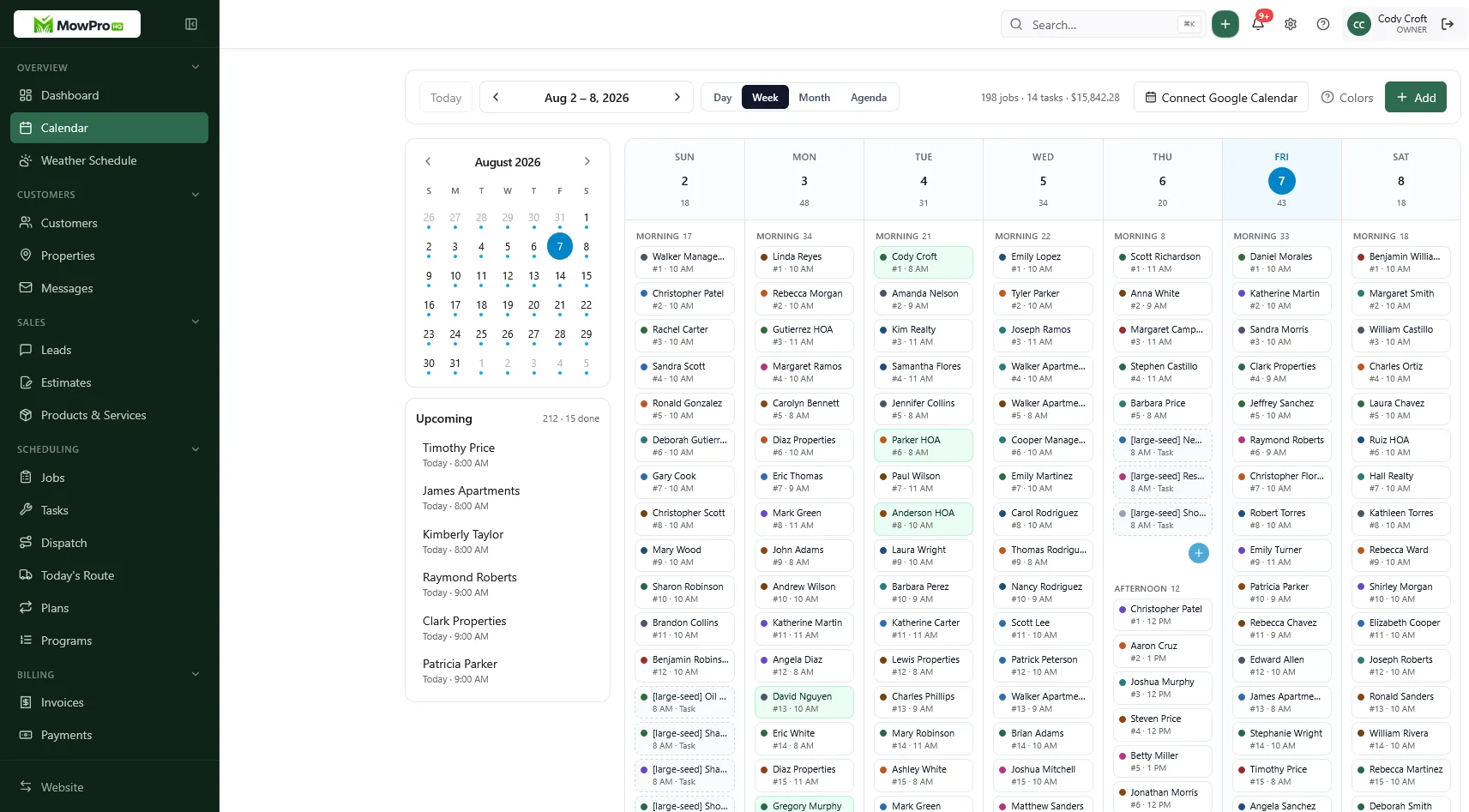
MowProHQ can help organize customers, property notes, quotes, recurring work, and schedule changes so the office and field team are working from the same plan. Review current options on the pricing page, or sign up when you are ready to set up your routes.
The best spring schedule is not the fullest one. It is the one your team can complete safely, within realistic hours, while keeping customers informed when conditions change.
Frequently asked questions
- How do I prepare a lawn care schedule for spring rush?
- Start with recent job and drive-time data, reserve room for first-cut cleanups and weather recovery, and group recurring work by area. Set capacity from the hours your team can safely and legally work, then offer customers realistic service windows rather than exact times you may not be able to keep.
- Should I keep taking new lawn care customers during spring?
- Only while you have measured capacity in the relevant route. Favor leads that fit existing service areas, use a clear waitlist when a route is full, and review capacity after weather delays, callouts, or unusually long first cuts.
- How should I schedule initial cleanups versus recurring mowing?
- Estimate and schedule the initial cleanup separately because tall grass, debris, wet ground, and hauling can make it much longer than a normal visit. Begin the recurring plan after the property is under control and its regular service time is understood.
- When should I hire for spring demand?
- Begin recruiting and training before forecast demand exceeds the capacity of your current team. Do not count a new employee as full capacity until onboarding, safe equipment use, route procedures, and required employment documentation are complete.
- How can I reduce customer calls during spring rush?
- Explain the expected service window, weather policy, first-cut scope, and update process before work begins. When conditions change, send one prompt update with a revised window instead of making a series of uncertain promises.
- What is a lawn care waitlist and when should I use one?
- A waitlist records customers you may be able to serve when a specific route or time period has room. Use one when accepting more work would threaten existing commitments, crew safety, service quality, or reasonable working hours, and avoid promising an opening you cannot confirm.
- How should weather affect spring lawn care scheduling?
- Use local history and short-range forecasts to reserve recovery time, but reassess conditions on the day of service. Rain, saturated soil, lightning, wind, heat, and poor visibility can change what is safe or appropriate, so communicate a window and move route clusters when practical.