
MowProHQ Blog/Growth
Scaling from Solo Lawn Care to a Crew Without Losing Quality
A practical guide to hiring a lawn care crew, covering pricing, payroll, training, safety, quality control, vehicles, and sustainable growth.
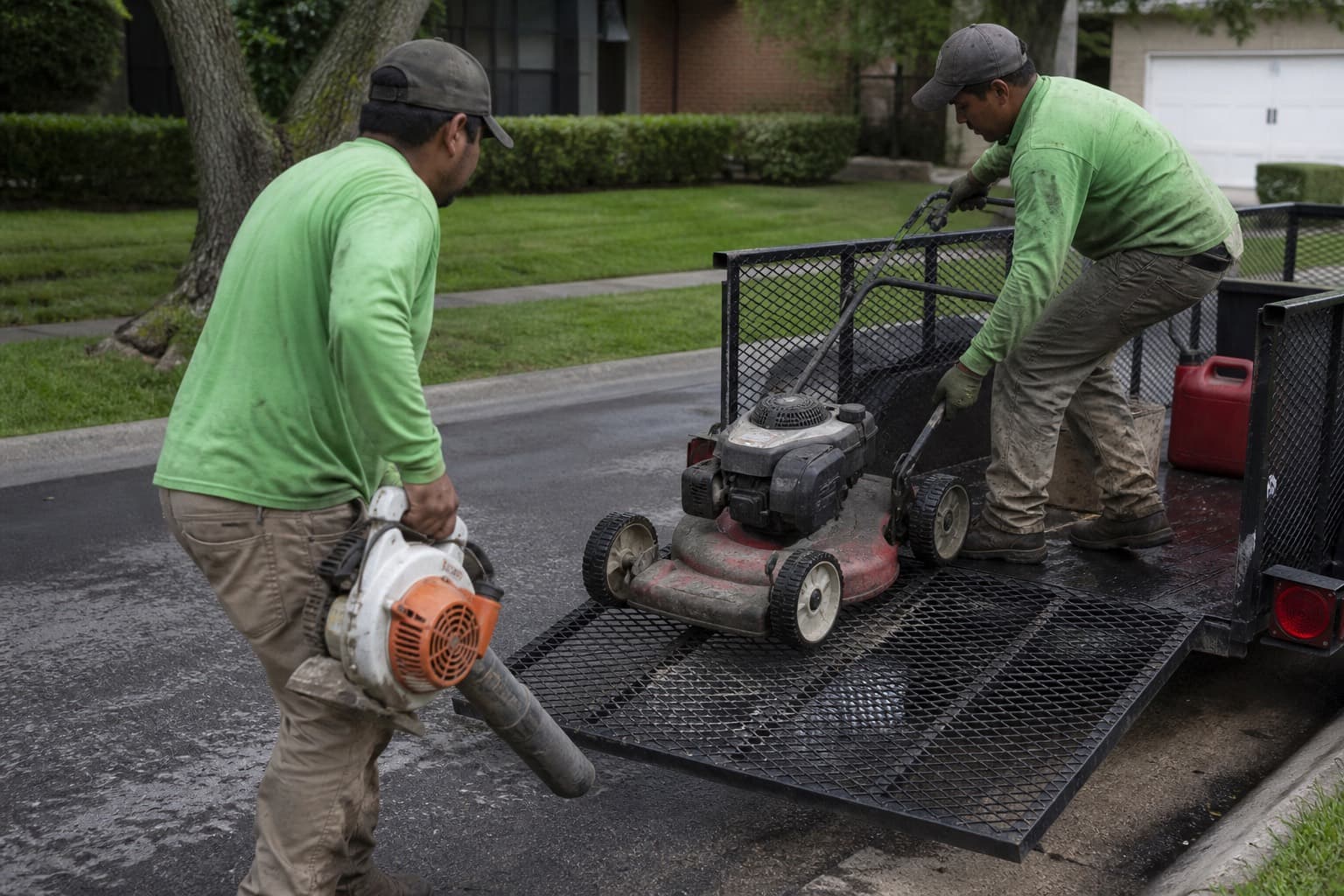
Going from solo lawn care to a crew changes more than capacity. You become responsible for another person’s pay, training, safety, and working conditions while customers still expect the same result at every property.
The safest way to grow is to make the work teachable before adding payroll. A new employee should not need access to everything in your head to complete an ordinary route.
Decide whether a hire solves the real problem
First identify the constraint. If good local work is waiting and you cannot serve it safely, labor may help. If the problem is scattered routes, weak collections, underpriced work, or equipment downtime, adding a person can make the problem more expensive.
| Question | Evidence to review | What it tells you |
|---|---|---|
| Is demand durable? | Accepted work, declined qualified leads, renewal history | Whether work is likely to remain after peak season |
| Are routes workable? | Drive time, on-site time, delays by route | Whether added labor will produce useful capacity |
| Can cash support payroll? | Cash balance, receivables, tax obligations, slow-week forecast | Whether pay can remain reliable when weather changes |
| Is the work transferable? | Schedule, scopes, property notes, checklists | Whether someone can work without constant calls |
| Is quality measurable? | Callbacks, rework, customer notes | Whether training has a clear target |
Build the forecast with conservative assumptions. Include rainy days, cancellations, payroll due before customers pay, repairs, and the time you will spend supervising instead of producing.
If the basics still live in texts and memory, start with the lawn care operations checklist and a customer and property CRM.

Put the operating system in place first
You do not need a large-company handbook for one hire. You do need a dependable source of truth.
Customer and property records. Keep service addresses, contacts, access instructions, hazards, pets, scope, and billing details together. Limit sensitive information to people who need it. These property-note practices help information survive the move from owner to crew.
A shared schedule. Publish the next workday early enough for the employee to prepare. Record weather changes and customer requests in the same place instead of creating separate text-message versions. See the guide to lawn care scheduling software.
A clear quote-to-invoice path. The crew should see what was sold without deciding prices at the property. Use written lawn care quotes and a repeatable invoicing process.
A job checklist. Define what is included, what is excluded, the completion standard, and what requires owner approval. Keep it short enough to use. Start with these practical crew checklists.
Time and payroll records. Choose a reliable way to record all compensable time, corrections, breaks where required, and approvals. Payroll records should not depend on reconstructed texts or route estimates.
| Area | Fragile solo habit | Crew-ready practice |
|---|---|---|
| Schedule | Rebuilt each morning | Shared, current work list |
| Scope | Owner remembers the promise | Written scope attached to the job |
| Property knowledge | Gate codes and hazards in memory | Controlled, property-specific notes |
| Quality | “Do it how I do it” | Observable completion checklist |
| Time | Estimated after the week | Contemporaneous, reviewable records |
| Changes | Customer texts one person | Change logged with the job |
Classify the working relationship carefully
Calling a worker a “1099 helper,” paying by the job, or having them sign a contractor agreement does not by itself make them an independent contractor. Federal, state, and local tests can differ and may consider control, economic dependence, opportunity for profit or loss, permanence, and whether the work is central to the business.
A person who follows your recurring route, uses your equipment, wears your uniform, works under your direction, and performs the lawn care you sell may be an employee under applicable law. Misclassification can lead to back wages, overtime, payroll taxes, insurance problems, penalties, and personal liability.
Before the first workday:
- Ask a qualified local employment or tax professional which classification rules apply.
- Register for required federal, state, and local payroll accounts.
- Complete required hiring forms, new-hire reporting, notices, and work-authorization steps.
- Confirm workers’ compensation and unemployment-insurance obligations.
- Check local rules for paid leave, predictive scheduling, meal and rest periods, final pay, youth employment, and pay-frequency requirements.
This article is operational guidance, not legal, tax, insurance, or employment advice. Rules vary by location and change over time; verify them with the relevant agencies and advisers.
Budget with loaded labor cost
The wage is only one part of the cost. Build a loaded labor rate from your actual obligations:
Loaded labor cost per paid hour
= wage + employer payroll taxes + workers’ compensation + unemployment costs + benefits + paid nonproductive time
Then include the rest of the operation:
Operating cost per crew hour
= loaded labor for everyone on the crew + vehicle and equipment cost + fuel + allocated overhead
Finally, calculate what the route must produce:
Required revenue per crew hour
= operating cost per crew hour ÷ (1 - target operating margin)
The target margin is a planning choice, not a universal lawn care benchmark. Set it with your accountant or financial adviser using your taxes, debt, replacement needs, seasonality, and risk.
| Cost category | Items commonly missed |
|---|---|
| Labor | Training, loading, meetings, travel between jobs, lawful breaks, overtime |
| Payroll | Employer taxes, payroll service, unemployment costs |
| Insurance | Workers’ compensation, commercial auto, general liability, endorsements |
| Equipment | Repairs, blades, trimmer line, depreciation, replacement reserve |
| Vehicle | Fuel, maintenance, tires, registration, financing |
| Overhead | Software, phones, bookkeeping, uniforms, shop, owner management time |
Compare required revenue with actual route performance. A useful measure is:
Revenue per crew hour = route revenue ÷ total crew hours attributable to that route
Use a consistent method for travel, loading, and other paid time. Do not improve the number by quietly excluding time that must legally be paid. The lawn care hourly rate calculator and pricing guide can help organize your assumptions.
Handle payroll and overtime before they become emergencies
Use a payroll process that calculates withholding, employer taxes, filings, and pay statements for the places where employees work. Keep enough cash reserved to pay wages and remit taxes even when customers pay late.
Do not assume that salary, day rate, piece rate, or a “crew lead” title removes overtime eligibility. Many field employees are nonexempt, and overtime rules can vary by jurisdiction. Compensable time may include loading, required meetings, travel between job sites, equipment cleanup, and work performed through calls or messages outside the scheduled route.
Document a time-correction process and never encourage off-the-clock work. Review timeclock habits for lawn care crews, then have a local payroll or employment professional confirm how the rules apply to your operation.
Train for quality and safety together
Do not teach speed first and add safety later. Begin with the hazards the employee will actually encounter and document the training.
Cover at least:
- Pre-use equipment inspections, guards, shutdown procedures, and manufacturer instructions
- Required personal protective equipment and its proper fit and care
- Thrown-object zones, bystanders, children, pets, slopes, traffic, heat, noise, and weather
- Safe fueling, battery charging, transport, loading, and trailer procedures
- Chemical handling only for employees who are trained, authorized, and legally permitted
- Incident, injury, near-miss, damaged-property, and equipment-defect reporting
- Emergency contacts, first aid arrangements, and when work must stop
Applicable OSHA or state-plan requirements may call for more, including hazard communication, safety data sheets, heat-illness measures, respiratory protection, hearing conservation, or recordkeeping. Pesticide and fertilizer work can also require separate licensing, supervision, notices, or records. Check the rules where you operate.
A practical training progression is:
| Stage | Employee practices | Owner verifies |
|---|---|---|
| Orientation | Policies, hazards, PPE, equipment checks, reporting | Understanding and documentation |
| Demonstration | Normal tasks under direct supervision | Safe sequence and quality standard |
| Guided work | Leads selected tasks while observed | Judgment, communication, property care |
| Limited independence | Handles suitable stops with support available | Accurate notes, safe work, completed scope |
| Ongoing coaching | Reviews exceptions and new hazards | Trends in callbacks, incidents, and retraining |
Advance based on demonstrated competence, not a fixed number of days. Some people and tasks require more supervision. Crew scheduling practices should support the training plan instead of forcing a new worker onto work they are not ready to perform.
Protect the business with the right insurance
Tell your insurance agent exactly how the business is changing. A solo policy may not cover employees, additional drivers, trailers, stored equipment, pesticide applications, or the way vehicles are used.
Discuss general liability, workers’ compensation, commercial auto, tools and equipment, hired or non-owned auto, employment practices, umbrella coverage, and any chemical-application endorsements that fit your work. Ask whether employees driving personal vehicles for company tasks creates a gap.
Get coverage confirmed in writing before exposure begins. “My truck is insured” is not the same as having appropriate commercial coverage for an employee towing business equipment.
Add vehicles deliberately
A second worker does not automatically require a second truck. First decide whether the role is a helper on the existing crew or an operator of a separate production unit.
Before allowing anyone to drive:
- Verify the license and any required endorsements.
- Follow your insurer’s driver-approval process.
- Set written rules for seat belts, phones, backing, passengers, keys, crashes, fueling, towing, and take-home use.
- Train and document trailer coupling, load securement, weight limits, and backing.
- Maintain inspection and service records for vehicles and trailers.
- Confirm federal, state, and local commercial-vehicle rules for your vehicle, trailer, weight, and operating area.
Vehicle thresholds and licensing rules depend on the exact setup and jurisdiction, so generic internet advice is risky. Ask your motor-vehicle agency, transportation regulator, insurer, and qualified adviser about your specific combination.
Keep quality without inspecting every property
Quality control should reveal where the process failed, not merely whether the truck arrived.
- Put the scope and completion standard on the job.
- Record property-specific hazards and customer instructions.
- Require the employee to report exceptions before improvising.
- Review a rotating sample of completed work.
- Log callbacks, rework, damage, and compliments by cause.
- Update the note, checklist, training, or scope when a pattern appears.
Photos can help with first visits, unusual conditions, damage, or disputed scope. Establish rules for privacy, customer consent where needed, storage, and acceptable use. GPS can support day-of dispatch, but neither GPS nor photos prove that edging, cleanup, or customer communication met the standard.
Useful measures include:
| Measure | What to learn |
|---|---|
| Scheduled work completed | Whether plans match real capacity |
| Callback or rework rate | Where quality or scope breaks down |
| Revenue per crew hour | Whether route economics support labor |
| Paid hours versus planned hours | Where estimates, travel, or delays are wrong |
| Incidents and near misses | Where controls or training need improvement |
Review trends against your own baseline. There is no universal “good” stop count because lot size, terrain, service scope, equipment, traffic, and crew experience vary.
Know when a second crew is justified
A helper beside you is added labor; a second crew is another unit that can safely complete its own route. Consider that next step only when:
- The first crew follows the system without constant owner intervention.
- Qualified demand is sustained and concentrated in current service areas.
- Actual route data supports another payroll, vehicle, equipment set, and insurance.
- A conservative forecast still works through weather delays and seasonal slowdowns.
- You have someone ready to lead safely and communicate exceptions.
Route density matters more as crews multiply. Use your own drive-time and job-time data with route planning and dispatch. Recurring work can make demand easier to plan when it fits the customer and your market; see recurring mowing plans.
In MowProHQ
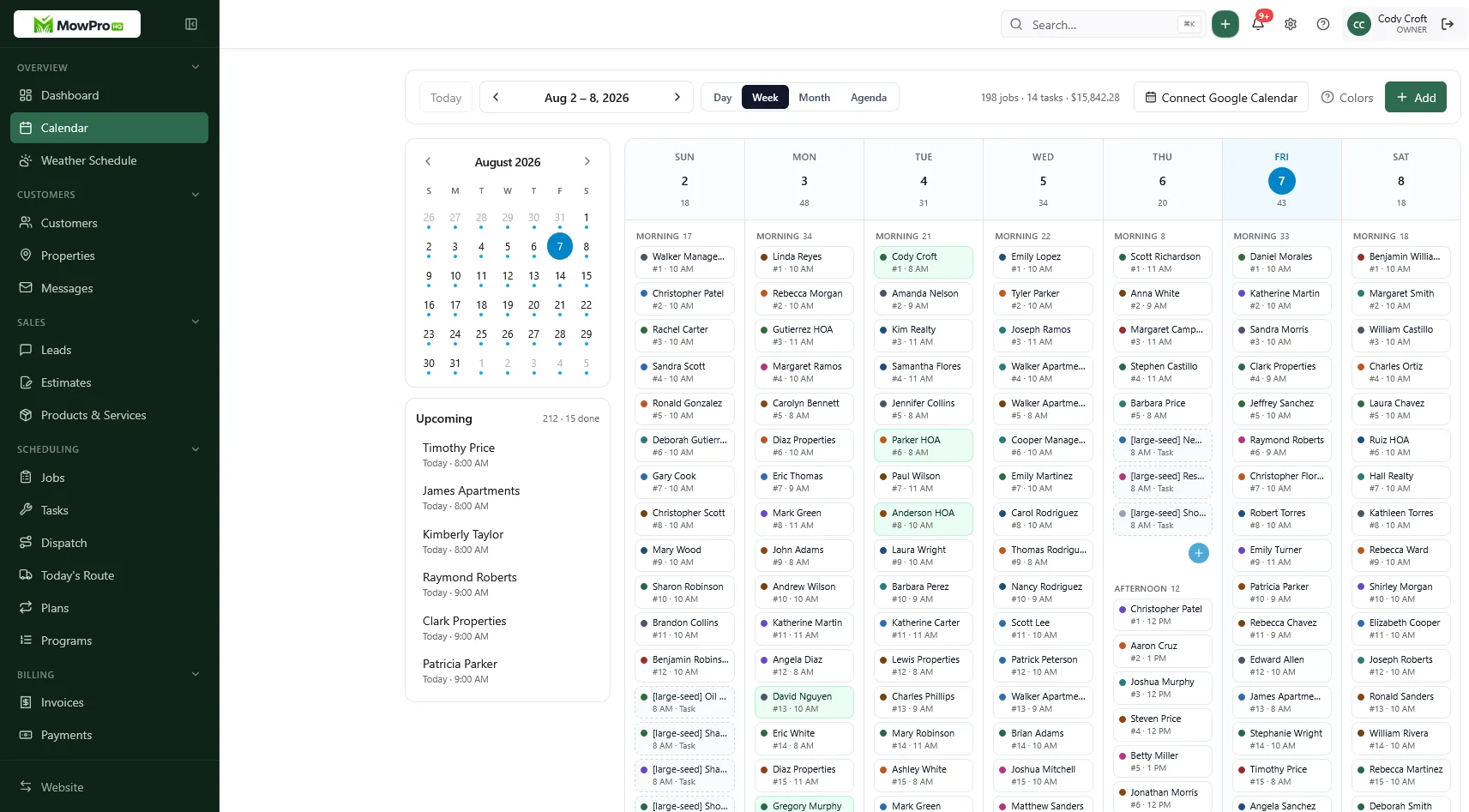
Using MowProHQ as you grow
MowProHQ can keep customer records, property notes, schedules, quotes, invoices, and crew information in one workflow. Review the current plans and included features on the pricing page. If it fits how your company works, you can sign up here.
The goal is not to stop being careful. It is to make careful work repeatable: classify and pay people correctly, train them safely, price from complete costs, and give the crew enough information to serve the customer without guessing.
Frequently asked questions
- How do I know I am ready to hire?
- A hire may make sense when profitable work is regularly going unserved, your routes are reasonably dense, and your cash forecast can cover wages, payroll costs, insurance, equipment, and slower weeks. Document the schedule, property notes, and quality standard before someone else depends on them.
- Should my first hire be a helper or a second operator?
- Hire a helper if you plan to stay on the truck and need another set of hands. Hire an operator only when that person can safely run work from a clear schedule, property notes, and written standards. The title does not determine whether someone is an employee or contractor; the actual working relationship and local law do.
- What systems should I install before payroll?
- Set up customer and property records, a shared schedule, written job scopes, timekeeping, payroll, training records, and a quality checklist. Confirm tax registration, workers’ compensation, unemployment insurance, wage-and-hour rules, and required notices with qualified local advisers and agencies.
- How should I price after adding labor?
- Use loaded labor cost rather than wages alone. Include employer payroll costs, insurance, paid non-billable time, equipment, vehicles, overhead, and the owner’s management time. Then compare required revenue per crew hour with what each route actually produces.
- How do I keep quality up when I am not on every lawn?
- Define what complete means, attach property-specific notes to each job, train against the same checklist, and review callbacks and a rotating sample of completed work. Use photos where they are useful and lawful, but do not treat GPS or a photo as proof of workmanship.
- When should I add a second crew?
- Consider another crew when the first one performs consistently without constant owner intervention, demand is concentrated in areas you already serve, and a conservative cash forecast supports another vehicle, equipment set, insurance, and payroll. Use your own route data instead of generic stop-count targets.
- Does software need to wait until I have a crew?
- No. A shared source for customers, properties, schedules, quotes, invoices, and job notes is useful before the first hire. Choose software based on your workflow, legal recordkeeping needs, and current plan details.