MowProHQ Blog/Scheduling
Weather Reschedules for Lawn Care Routes Without the Chaos
A practical process for safely rescheduling lawn care routes, notifying customers, protecting route density, and handling weather-day billing and labor.
Weather does not have to turn a lawn care schedule into a week of improvised promises. A practical weather plan answers four questions before the storm arrives: who makes the call, when work must stop, where postponed jobs go, and what customers and employees should expect.
The goal is not to force every missed stop into the next day. It is to protect people and property first, then recover as much work as capacity and conditions reasonably allow. A shared process—supported by lawn care scheduling software and sensible route planning—keeps the office and field team working from the same plan.
Put one person in charge—without taking away stop-work authority
A route-wide weather decision needs an owner, usually an operations manager, dispatcher, or owner. That person should check reliable local forecasts, alerts, road conditions, field reports, and the day's work before delaying or moving a route.
Crew leaders still need clear authority to pause or stop a job when conditions at the property are unsafe. A centralized schedule should never require someone in the field to continue through lightning, flooding, unstable soil, dangerous heat, high wind, poor visibility, or unsafe equipment conditions.
Use decision checkpoints that fit your climate and start times. Avoid turning an example time or forecast percentage into an automatic go/no-go rule.
| Checkpoint | What to review | Possible action | | --- | --- | | Before the workday | Current forecast, watches and warnings, likely route conditions, customer restrictions | Prepare a delay, cancellation, alternate work, or revised window | | Before dispatch | Official alerts, roads, lightning risk, heat plan, crew and equipment readiness | Release, hold, shorten, or move the route | | On arrival | Standing water, soil firmness, slopes, access, overhead hazards, turf condition | Service, modify the scope, defer the property, or leave | | During work | Changing weather, alerts, crew reports, equipment performance | Continue only while the work remains safe and within policy |
Record who made the route decision and why. This gives the office a dependable answer and helps improve the policy after the season.
Check more than rain
“Light rain” is not a complete safety assessment. Conditions can vary from one neighborhood—or one part of a property—to another.
Lightning, storms, and wind
Use official local alerts and a written lightning plan. The National Weather Service advises going indoors when thunder is heard and provides guidance for waiting before outdoor activity resumes. Do not shelter under trees, in open trailers, or in other locations that official guidance does not recognize as safe.
Storm cells can also bring falling limbs, flying debris, reduced visibility, and power-line hazards. Train crews to avoid downed lines, report the location to the proper utility or emergency authority, and follow local emergency instructions. Do not use a rigid wind or lightning threshold unless it comes from applicable law, official safety guidance, or the manufacturer of the equipment being used.
Heat and air quality
Wet weeks can push make-up work into hotter days. Follow the OSHA heat illness prevention guidance, applicable state or local rules, and your written heat plan. Consider acclimatization, water, rest, shade, workload, protective clothing, humidity, direct sun, and each worker's symptoms—not temperature alone.
Build extra time into the make-up plan rather than compressing breaks or extending work automatically. Also review official air-quality alerts when smoke, ozone, or dust may affect outdoor work.
Flooding, roads, and standing water
Do not route crews or trailers through flooded roads or around barricades. Follow emergency management and transportation warnings. Standing water can conceal holes, debris, electrical hazards, displaced wildlife, and unstable edges; a property that is reachable may still be unsuitable for service.
Soil and turf conditions
Walk questionable areas before unloading equipment. Warning signs include tires sinking or slipping, footprints holding water, unstable slopes, saturated drainage paths, and likely rutting or soil compaction. Conditions may support hand work but not a heavy mower. Record a site-specific deferral instead of treating the entire route as identical.
Quality matters too: mowing saturated turf may tear grass, leave clumps, spread some diseases, or create cleanup the normal visit does not cover. Base the call on the turf, soil, mower, slope, and promised scope—not a universal number of hours after rain.
Equipment, chemicals, and manufacturer instructions
Consult the operator's manual and manufacturer guidance for each mower, trimmer, blower, battery, charger, trailer, and other tool. Observe warnings about wet operation, slopes, traction, guards, electrical exposure, transport, and maintenance. Do not assume that because one machine can be used in damp conditions, another can too.
For fertilizers, herbicides, pesticides, or other regulated products, the product label and applicable law control. Wind, rain, runoff risk, temperature, and re-entry requirements may make an application unsuitable even when mowing can continue.
Move the route first, then manage exceptions
Rebooking every property separately can scatter a dense route across several days. Start with the affected route, day, or neighborhood cluster:
- Hold or move the cluster. Keep its normal order when practical.
- Review capacity. Include travel, daylight, breaks, equipment, disposal time, and expected site conditions.
- Pull out real exceptions. Contract deadlines, access windows, events, or site-specific hazards may justify separate handling.
- Fill only compatible openings. Favor nearby work instead of promising a distant stop simply because it is first in the inbox.
Whether the team uses a dispatch workflow or paper, there should be one source of truth. A private text promising to “squeeze it in” is not a schedule change until the job and crew calendar are updated.
What must travel with the job
When a stop moves, keep these details attached:
- Gate, lockbox, pet, and access instructions
- Known property hazards and customer restrictions
- Service checklist, add-ons, and chemical tasks
- Billing status and contract requirements
- Photos, prior crew notes, and customer communication history
Property notes remain relevant when the date changes. Confirm temporary details—such as construction access or a one-day event—rather than assuming they still apply.
Example: part of Tuesday North is saturated
The office checks alerts and crew reports, then learns that low river lots remain saturated while the higher streets are serviceable.
- The dispatcher keeps the safe portion of the route in sequence.
- The saturated cluster moves together to a tentative later window.
- Contract-sensitive sites are reviewed individually, without overriding safety or property conditions.
- Customers receive the appropriate service window and policy reminder.
- The office marks completed, deferred, and skipped visits distinctly so billing and payroll records match the work.
This preserves density without pretending every property will dry at the same time. The same logic applies to dump runs and route time: travel and non-mowing work still consume capacity.
Customer notification templates
Send a clear notice as soon as the decision is reasonably settled. Use a realistic window rather than a precise promise the forecast may invalidate.
Include:
- The affected property or service
- Whether the visit is delayed, tentatively rescheduled, or skipped under the agreement
- The next service window, if known
- What the customer needs to do about access
- How billing or scope will be handled, if the answer is not already in the contract
Use only communication channels the customer has agreed to receive, honor opt-outs, identify the business, and follow applicable telephone, text, email, and privacy laws. Keep operational messages focused on the requested service; do not treat service consent as automatic marketing consent. See texting lawn care customers for a broader messaging workflow.
Weather-delay scripts
Adapt these to the actual contract and conditions.
Residential weekly
Weather update from Green Street Lawn Care: we cannot safely service 1842 Oak Lane today. We are tentatively moving your visit to Thursday–Friday, conditions permitting. We will message you if that window changes. Reply if access instructions have changed.
Residential biweekly
Weather update from Green Street Lawn Care: today's visit at 1842 Oak Lane is postponed. Under your service plan, we will [attempt service during DATE RANGE / resume on NEXT DATE]. If growth requires work outside the regular scope, we will get approval before adding a charge.
Commercial / HOA
Weather update for Oak Park common areas: service is delayed because current conditions are unsuitable. Our tentative service window is Thursday–Friday, subject to site and weather conditions. Please send any event, gate, or access restrictions to [CONTACT]. Contract-specific priority areas remain noted.
Mid-route abort
Weather update from Green Street Lawn Care: we stopped the remaining route because conditions changed. Your property was not completed. We are reviewing the next safe route window and will update you by [TIME/DAY]. No action is needed unless access has changed.
Do not say a visit was completed when it was not, and do not invent a fee during the disruption. Use clear statuses such as “weather delayed,” “partially completed,” “skipped per agreement,” and “completed.” Those records support accurate invoice and collection workflows.
Preserving sequence and density after moves
| Deferred work | Practical starting point |
|---|---|
| Whole route | Next workable window in the same zone, subject to capacity |
| Partial route | Keep the unfinished cluster together when practical |
| Site-specific wet area | Recheck the site rather than holding every dry property |
| Contract deadline or event | Review as an exception and document the agreed priority |
| New or distant work | Add only if it fits after existing commitments and safety needs |
Preserve the familiar sequence unless access, road closures, equipment, or site conditions give you a reason to change it. If you optimize routes, run the new plan using the jobs that can realistically be performed—not every postponed stop plus unrelated last-minute work.
Weather recovery is also a pricing and capacity decision. A long drive for one deferred job, a storm-debris cleanup, or overgrown turf may involve work outside the recurring scope. Review how to price lawn care jobs and obtain customer approval before adding work or charges.
Capacity math for the make-up day
If Thursday was already full, Tuesday's route does not become free capacity. Consider:
- Moving a cluster to more than one nearby window while preserving geography
- Deferring optional add-ons with customer approval
- Skipping a cycle only when the agreement allows it
- Limiting new one-off work until existing commitments are addressed
- Using alternate indoor or maintenance work when outdoor service is unsafe
During spring rush, do not recover capacity by assuming crews can work indefinitely. Revise the schedule based on safe hours, available daylight, travel, and the actual condition of each route.
Protect employee hours and overtime compliance
Weather delays do not suspend wage-and-hour rules. Track all compensable time accurately, including required pre-trip work, loading, travel between job sites, equipment care, meetings, and other duties as applicable. Do not ask employees to perform unpaid work while waiting for a route decision.
Before extending a make-up day:
- Check federal, state, and local rules on hours, overtime, breaks, reporting time, predictive scheduling, and minor employees.
- Apply the overtime workweek consistently; moving hours to another day does not necessarily avoid overtime.
- Confirm that the plan still follows heat, fatigue, and driving-safety procedures.
- Tell employees how a closure affects reporting, available paid leave, alternate work, and on-call expectations under company policy and applicable law.
- Keep payroll records aligned with dispatch and timekeeping records.
The U.S. Department of Labor and the relevant state or local labor agency are starting points, but requirements vary. Use qualified legal or payroll advice for your business and workforce.
Put make-up, contract, and billing rules in writing
Weekly, biweekly, monthly, and on-demand services may need different weather rules, but there is no universal schedule that fits every climate or contract. Define the policy in the recurring service plan, proposal, and agreement.
Address:
- Whether service is billed per completed visit, on a flat monthly program, or another basis
- Whether weather delays move the visit or may skip a service cycle
- How partial work and approved add-ons are billed
- What happens when repeated weather creates extra growth or debris
- Which service windows are estimates and how schedule changes are communicated
- Any notice, cancellation, access, refund, credit, or termination terms
Do not automatically bill a per-visit customer for a visit that did not occur. For flat-rate agreements, explain that payment structure before service begins and apply the written terms consistently. Local contract, consumer-protection, tax, and auto-renewal requirements can vary.
Here is cautious sample language to review for your own agreement:
Weather may require us to delay, modify, or skip service when conditions are unsafe or may damage the property. We will provide an updated service window when practical. Billing, credits, and work outside the regular scope will follow your service agreement; we will request approval before performing separately priced work.
Storm debris, fallen limbs, standing-water remediation, and unusually heavy growth may fall outside routine mowing. Describe and quote added work before performing it.
In MowProHQ
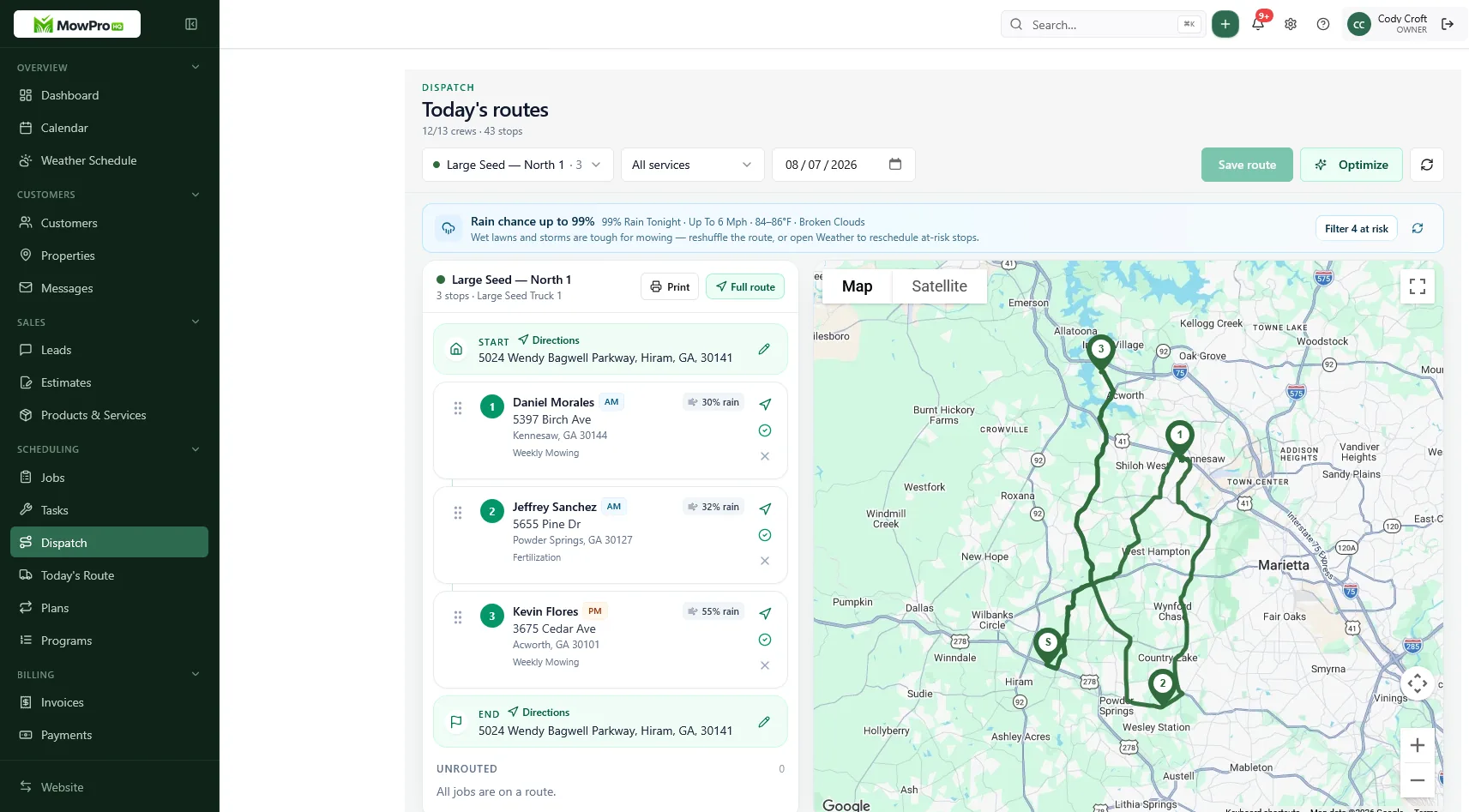
How MowProHQ helps
MowProHQ brings scheduling, dispatch, customer details, property notes, and field records into one workflow so weather changes are easier to coordinate. It does not replace safety judgment, manufacturer instructions, contracts, or labor-law compliance.
Review current pricing or sign up when you are ready to organize weather-day routes in the same system as the rest of your work.
Frequently asked questions
- Who should decide whether to cancel a lawn care route for weather?
- Assign an office or operations lead to make route-wide decisions, while giving crew leaders authority to stop work immediately when conditions become unsafe. Document who decides, what information they check, and how the change is communicated.
- Should I reschedule every lawn care stop individually after rain?
- Usually, no. Move the affected route or neighborhood cluster together first, then handle genuine exceptions. This helps preserve route density and keeps property notes, access details, and service tasks attached to each job.
- How do I tell customers their mowing was rained out?
- Send a short notice through a channel the customer has agreed to use. State that weather prevented service, give a realistic service window rather than an unsupported promise, and explain how the customer can report access changes or urgent concerns.
- How do I keep route density after a rain week?
- Keep make-up work in its existing zone and preserve the normal stop sequence when practical. Add work only after checking crew capacity, daylight, travel time, and safe working conditions.
- Do weekly and biweekly plans get the same make-up rules?
- Not necessarily. The policy should reflect the service frequency, turf condition, season, contract, and available capacity. Put the weather and skipped-service terms in the quote or agreement instead of deciding them during each storm.
- Can a lawn crew work in light rain?
- Rain intensity alone does not settle the question. Check lightning and flood hazards, heat and wind, visibility, soil stability, turf damage risk, chemical labels, and the equipment manufacturer’s instructions. A crew must be able to stop work when conditions are unsafe.
- What should stay on the job when I move a rain day?
- Keep property notes, access instructions, hazards, pets, service checklists, add-ons, chemical restrictions, contract terms, and billing status attached to the rescheduled job.