
MowProHQ Blog/Scheduling
Holiday and Vacation Weeks for Lawn Care Routes
Plan lawn care routes around holidays and customer vacations with clear calendars, skip rules, route-slot policies, and practical make-up limits.

Holiday closures and customer vacations both change the route you expected to run. Without a clear policy, the office, crew, and customer may each assume a different make-up date.
This playbook sits next to pause and skip rules, weather reschedules, recurring plans, and route planning.
Publish the company holiday calendar
Choose planned closure dates before the busy season. Include them in customer onboarding, and remind affected customers before each holiday.
Typical lawn-care choices:
| Day | Common move | Customer message |
|---|---|---|
| New Year’s / Christmas week | Close or run a limited route | State the next planned service date |
| Memorial Day | Work, close, or shift the route | Give the revised window or skip terms |
| July 4 week | Decide based on demand and staffing | Send the published plan |
| Labor Day | Work, close, or shift the route | Give the revised window or skip terms |
| Thanksgiving week | Close or run a limited route | Confirm the restart date |
If you work, give customers a realistic window and confirm employee scheduling and pay comply with your policies and applicable law. If you close, explain whether each visit moves, receives a credit, remains part of a flat-rate plan, or resumes on the next regular date.

Customer vacation is a skip or a pause
Classify a vacation request under the same terms as your pause policy. A single missed visit can be a skip; a longer absence can be a pause with a start and end date. An open-ended request needs a clear deadline and route-slot decision.
Vacation script
Please send the dates you will be away. We will skip the listed visits and resume on [date/day or next available opening]. If the lawn needs extra work when service resumes, we will send a catch-up quote first. We hold regular route slots for up to [policy].
After an extended pause, assess the property before promising an ordinary visit. Heavy growth may need the equipment, time, and pricing used for an overgrown first cut.
Hold vs release
| Hold length | Slot | Why |
|---|---|---|
| Short pause with required notice | Usually hold | Easy to plan around |
| Longer pause with fixed dates | Apply the written hold policy | Prevents an uncertain restart |
| Open-ended pause | Set a deadline or release | The route cannot remain uncertain indefinitely |
| Nearby customer waiting for service | Apply the same cap consistently | Balances existing and new demand |
Use the same written rule for similar customers. Consistency is easier to explain than making a different promise in every conversation.
Do not stack make-ups
Holiday closures, customer vacations, and rain delays can affect the same route. Without a priority rule, promised make-ups can exceed the time available the following week.
Pick a simple stack rule and publish it:
- Customer vacation: follow the agreed skip and billing terms
- Company holiday: use the published make-up, credit, or next-visit rule
- Weather: offer the window defined in your weather-reschedule policy
- Consecutive skips: inspect the growth and quote extra work when needed
Do not let crews promise extra visits without checking route capacity and customer terms.
Rebuild the route for the holiday week
Enter confirmed skips before publishing the route, then rebuild each affected day from the stops that remain.
Holiday-week board:
- Remove confirmed pauses and skips
- Keep remaining stops grouped geographically
- Check drive time before adding one-off work
- Use open time for maintenance, disposal, training, or other planned work
- Notify customers if arrival windows change
A shorter, dense route may perform better than extending the day with distant stops. Update dispatch so the crew works from the current list rather than the prior week's route.
In MowProHQ
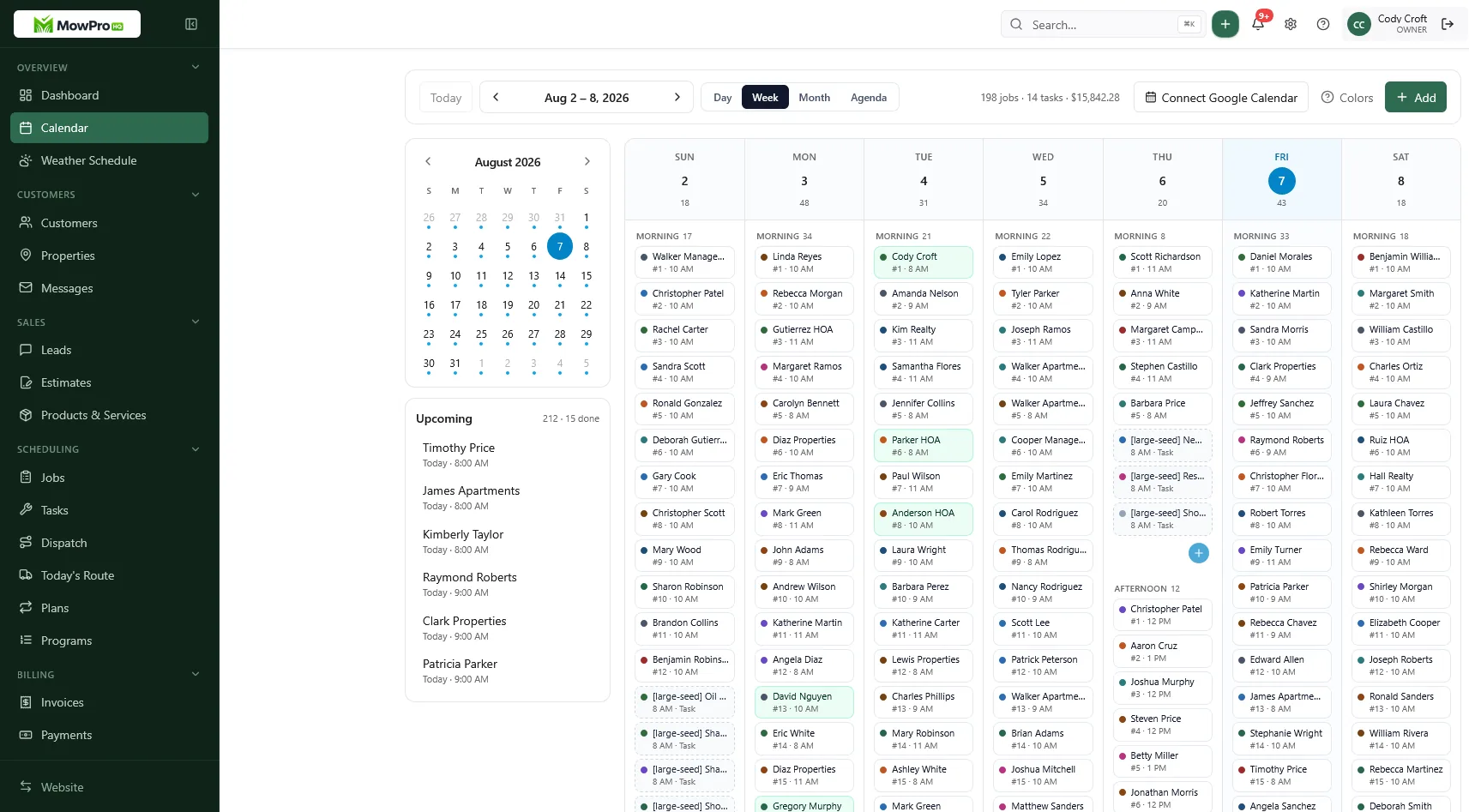
Worked example: July 4 week
A normal Thursday route has 22 weekly stops. Seven customers submit dated vacation pauses, leaving 15 scheduled visits. Rather than filling the openings with distant jobs, the manager keeps the remaining route compact and schedules necessary disposal time.
Two properties returning from longer pauses may need additional work. The office offers separate catch-up appointments based on available capacity; customers who decline remain scheduled for their next regular visit, subject to the condition of the lawn and the service agreement.
Leaving skipped jobs on the dispatch board or adding unpriced catch-ups would make the plan look fuller than the work the crew can reasonably complete.
Apply the same process in shoulder season
Early spring and late fall create similar route changes. Publish seasonal start and end rules, document any frequency and price changes, and prioritize work according to contracts and service needs. See end-of-season operations and spring scheduling.
Advance notice helps customers distinguish a planned seasonal change from a missed visit.
Office checklist (every holiday or vacation request)
- Is this a skip, pause, or company dark day?
- Are dates on the property?
- Does billing pause, receive a credit, or remain unchanged under the agreement? Match your prepay or monthly billing policy.
- Is a make-up required, and is there still capacity in the stated window?
- Has the recurring schedule been changed so the job will not regenerate incorrectly?
- Can the crew see the updated route?
Do not rely on memory to suppress or restart recurring jobs. Your scheduling system should preserve the dates and apply the change predictably.
Crew script when they ask in the driveway
The office confirms vacation changes and catch-up visits. I can send them your dates, and they will confirm the updated schedule.
Give crews a simple way to forward requests without making scheduling or pricing promises at the property.
Review each affected week
Track for Memorial Day, July 4, and Labor Day:
- Skips requested versus skips entered before dispatch
- Catch-ups quoted, accepted, and completed
- Planned versus actual finish times
- Callbacks the following week
- Route slots held or released under the policy
These results help identify unclear scripts, unrealistic route capacity, or a hold policy that needs revision.
Manage schedule changes in MowProHQ
MowProHQ keeps customer records, scheduled visits, quotes, and invoices together so holiday and vacation changes are visible to the office and crew.
Review current plans and pricing, then create an account and test the workflow with a sample closure, customer pause, restart date, and catch-up quote.
Frequently asked questions
- Should a lawn care company work holidays?
- That depends on customer demand, route density, staffing, and local rules. Decide before the season which holidays you will work or close, then tell customers whether affected visits will move or be skipped.
- How do I handle customer vacation weeks?
- Record the exact dates and treat the request as a skip or a dated pause under your service policy. Explain the billing effect, restart date, route-slot policy, and whether heavier growth may require a separately priced catch-up visit.
- Do I owe a make-up mow after a holiday or vacation skip?
- Follow the terms you gave the customer. Vacation skips, company closures, and weather delays may have different rules. State whether the visit moves, is credited, is included in a flat monthly plan, or resumes on the next regular date.
- How far ahead should I announce holiday closures?
- Publish planned closures with the seasonal calendar or at signup, then send a reminder before each affected week. Earlier notice gives customers and employees time to plan and reduces confusion about changed service days.
- Should I hold a vacationing customer’s route day?
- A short, dated pause may justify holding the regular slot. For longer or open-ended pauses, define when the slot may be released and whether service will restart on the old day or the next available opening.
- What do I do with a half-empty holiday Tuesday?
- Rebuild the route around the remaining dense stops. Depending on workload and employee arrangements, you might shorten the day, use a smaller crew, or schedule maintenance and training rather than adding distant one-off work.
- How do holiday weeks interact with weather delays?
- Use a written priority and cut-off rule for weeks affected by both weather and holidays. Explain what moves into a make-up window and what resumes on the next regular visit, subject to your service agreement and local requirements.