MowProHQ Blog/Recurring Revenue
Weekly vs Biweekly Lawn Mowing Service
Compare weekly and biweekly lawn mowing by workload, turf growth, route fit, price, weather policies, and customer expectations.

Weekly and biweekly lawn mowing are different maintenance plans, not the same visit divided by calendar frequency. The right choice depends on how quickly the lawn grows, what condition the customer expects between visits, and whether the schedule works efficiently for the crew.
That distinction matters when quoting. A 14-day interval can mean a longer visit, but it does not always mean exactly twice the growth or labor. Turf species, rainfall, irrigation, fertility, temperature, mowing height, shade, and season all affect the result. Use the property’s actual conditions whenever possible.
For broader estimating guidance, see how to price lawn care jobs, the hourly rate calculator, and recurring mowing plans.
Weekly vs biweekly lawn service
| Factor | Weekly service | Biweekly service |
|---|---|---|
| Typical fit | Active growth; customers wanting a consistently maintained look | Slower growth; customers comfortable with more change between visits |
| Work per visit | Often shorter and more predictable | May require slower mowing, extra passes, or more cleanup |
| Appearance between visits | Usually more consistent | More dependent on turf, weather, and irrigation |
| Routing | One repeating neighborhood day | Alternating A/B weeks need deliberate route design |
| Billing | More visits per season | Fewer visits, often at a higher per-visit price |
| Main risk | Weather backlog across a frequent route | Excessive growth after rain, a skip, or a delayed cycle |
Neither frequency guarantees a particular lawn height or appearance. A cool-season lawn during spring growth may need a different cadence than the same lawn during summer dormancy. Warm-season turf can also change quickly with heat, rainfall, and irrigation. Local conditions and safe mowing practices should drive the recommendation.
Monthly or on-demand mowing is a separate service. Those jobs are better treated as projects, as explained in one-time vs recurring mowing.
Price the work, not just the interval
Define the same base scope before comparing plans. For example, a core visit might include mowing accessible turf, string trimming, edging specified hard surfaces, and blowing clippings from paved areas. Clarify bagging, haul-away, beds, leaf cleanup, and inaccessible areas separately. See what a lawn mowing service includes.
Use this basic formula:
Visit price = (on-site labor minutes + allocated travel/loading minutes) × target revenue per minute + job-specific costs
If multiple crew members work at once, use labor-minutes or a crew-hour target consistently. Include disposal, unusually heavy clipping management, equipment, overhead, and profit in the target or as separate costs—but do not count the same cost twice.
Then compare plan totals:
Average monthly plan value = visit price × expected annual visits ÷ billed months
A true weekly schedule has 52 visits in a full year, or about 4.33 per month. Every 14 days has 26 visits, or about 2.17 per month. Do not use four and two unless the agreement specifically sells four and two visits per billing period. Seasonal businesses should use the contracted visit count instead.
Illustrative pricing math
This example uses a hypothetical $110 revenue-per-crew-hour target. It is not a recommended market rate.
| Plan | On-site time | Travel/loading allocation | Economic time | Calculated visit | Rounded example | Annualized monthly value |
|---|---|---|---|---|---|---|
| Weekly | 32 min | 8 min | 40 min | $73.33 | $75 | $325.00 |
| Every 14 days | 50 min | 10 min | 60 min | $110.00 | $110 | $238.33 |
The calculations are:
- Weekly:
40 ÷ 60 × $110 = $73.33, rounded here to $75;$75 × 52 ÷ 12 = $325.00 - Every 14 days:
60 ÷ 60 × $110 = $110;$110 × 26 ÷ 12 = $238.33
The biweekly time estimate must come from observation or a conservative trial estimate; it is not a universal multiplier. Gates, slopes, obstacles, mowing area, parking, clipping volume, and route position can matter more than lot size alone. Use lot-size quoting as a starting point, then adjust for the real property.
Choose frequency from the lawn and expectation
Weekly service is often appropriate when:
- Growth during the service season is consistently strong
- The customer wants a uniform, maintained appearance
- Longer intervals would require removing too much leaf blade at once
- Wet areas, slopes, obstacles, or clipping buildup make heavier visits impractical
- HOA, commercial, rental, or listing standards require a tighter appearance
Biweekly service can work when:
- Observed growth is moderate enough for safe, acceptable mowing
- The site is open and efficient
- The customer accepts a taller or less uniform appearance near the next visit
- The property fits a dense A-week or B-week route
- The agreement explains weather delays, skips, and excessive-growth work
Avoid promising that one schedule works for an entire season. A company may require weekly visits during local peak growth and allow a different cadence after growth slows, but the timing should reflect local turf and weather rather than fixed nationwide months. Spring scheduling should leave room for those changes.
A practical customer explanation
“Weekly service is designed for a more consistent appearance. Every-14-days service costs less over the season in this quote, but each visit is priced for the additional work we expect, and the lawn may look taller between visits. If a customer-requested skip causes excessive growth, we will quote the extra work before proceeding.”
Put the selected frequency, scope, and tradeoffs on the written quote.
Route biweekly work in A and B weeks
Biweekly service works best as two repeating route groups:
- Assign every account to Week A or Week B
- Keep both week groups geographically compact
- Record the cadence on the recurring job
- Preserve route order when weather shifts the schedule
- Avoid using distant biweekly stops merely to fill an isolated opening
| Tuesday pattern | Likely operational effect |
|---|---|
| Weekly stops concentrated in one area | Consistent weekly density |
| Biweekly stops scattered without A/B assignment | Alternating gaps and avoidable travel |
| A-week and B-week stops grouped in the same service area | More stable workload and route density |
Route planning and dispatch becomes easier when cadence is structured data rather than a note. Keep the boundary aligned with your service area.
Define weather delays and skips separately
“Skipped visit” can describe several different events. The agreement should say what happens in each one.
| Event | Reasonable policy to define |
|---|---|
| Unsafe weather or saturated ground | Company moves the visit within its stated weather window; no automatic surcharge solely because the company delayed it |
| Customer requests a skip | Next visit may be repriced if the added growth or debris changes the scope |
| Little or no growth | State whether the crew performs inspection/other maintenance, skips without charge, or bills under a flat seasonal plan |
| Access blocked by customer | Define notice requirements, trip charges, and rescheduling |
| Delay creates excessive growth | Get approval for double cutting, bagging, or cleanup before adding charges |
A weather delay does not automatically justify charging the customer for a cleanup. If the company controls the delay, the company should follow its written service window and communicate the revised day. A customer-requested gap is different because it changes the agreed cadence. See weather reschedules and texting lawn care customers.
For work outside normal maintenance, use a clearly named line item such as “excessive-growth cleanup” and explain the scope. First-cut and overgrown lawn pricing provides a framework. Invoices should show what was delivered rather than an unexplained surcharge.
Put the important terms in the agreement
A weekly or biweekly contract should cover:
- Service frequency and estimated annual or seasonal visit count
- Service-day window and weather-delay procedure
- Included mowing, trimming, edging, and blowing scope
- Treatment of clippings and any bagging or haul-away charge
- Customer skips, vacations, locked gates, pets, and blocked access
- Excessive-growth approval and pricing method
- Seasonal frequency changes and who can authorize them
- Per-visit versus flat monthly billing and how partial months are handled
- Cancellation, notice, renewal, and price-change terms
- Damage reporting and customer communication expectations
Flat monthly billing can make payments predictable, but it should identify the visit count or service season behind the monthly amount. Per-visit billing should state when a visit counts as completed. Contract language must match local law and the company’s actual practices.
Switching frequency mid-season
Treat a frequency change as a new plan, not an informal note:
- Inspect recent growth and estimate the new visit time
- Reconfirm the included scope
- Quote the new per-visit or monthly amount
- Set the customer’s appearance expectations
- Assign the property to an A or B week
- Confirm the effective date and skip policy in writing
| Request | Scheduling action | Pricing action |
|---|---|---|
| Weekly to biweekly | Assign A or B week | Recalculate per-visit work and plan total |
| Biweekly to weekly | Add the alternate-week slot | Recalculate visit price and plan total |
| “Come when it looks long” | Move to on-demand status | Quote each project under current conditions |
| Vacation pause | Document exact dates | Apply the contract’s restart or cleanup terms |
Add-ons should remain explicit at either frequency. Bagging, bed work, and debris hauling are not automatically included because a customer chose weekly service. See lawn care add-on pricing.
In MowProHQ
Managing recurring plans in MowProHQ
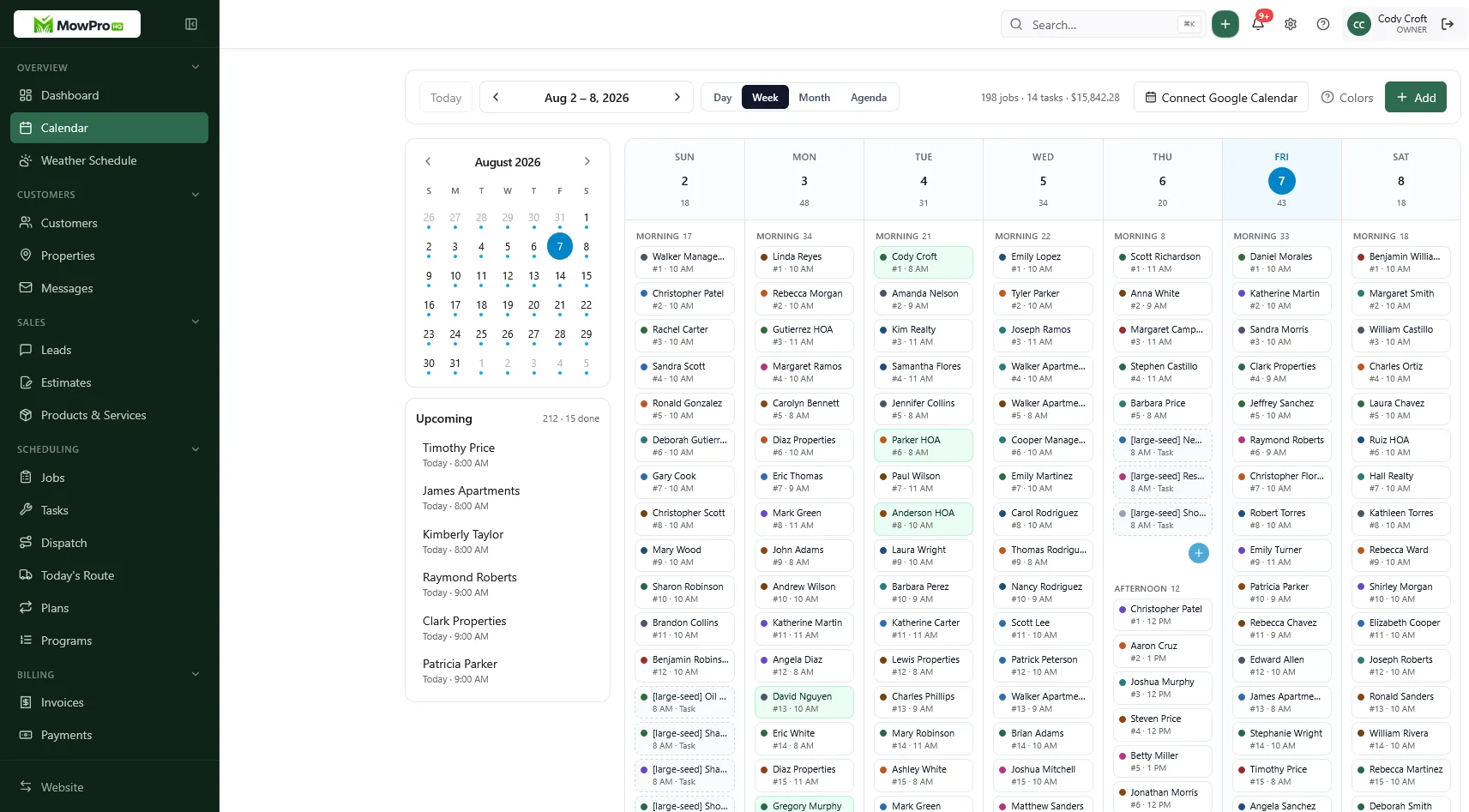
MowProHQ helps organize recurring jobs, customer details, scheduling, quotes, and invoices. Keep weekly and biweekly services as clearly named plans so frequency changes are reflected in both operations and billing.
Review current options on pricing, or create an account at signup.
The practical rule is simple: recommend a cadence the lawn can support, price the work you expect to perform, and write down how exceptions will be handled.
Frequently asked questions
- Is biweekly lawn mowing half the price of weekly?
- Usually not. A biweekly visit may require slower mowing, extra trimming, double cutting, or more cleanup. Estimate each frequency from its expected labor, travel, and disposal costs rather than dividing the weekly price by two.
- Is weekly or biweekly lawn mowing better?
- It depends on turf type, weather, irrigation, season, appearance standards, and route fit. Weekly service often suits active growth and a consistently maintained look. Biweekly service can suit slower growth and customers who accept more variation between visits.
- How many weekly or biweekly visits occur each month?
- A true year-round weekly schedule averages 4.33 visits per month, and an every-14-days schedule averages 2.17. Actual seasonal totals depend on the contract, service dates, weather policy, and local growing season.
- What happens when rain delays a mowing visit?
- The service agreement should define the arrival window and whether weather-delayed work shifts to the next safe day or later in the route. It should also distinguish a contractor weather delay from a customer-requested skip, because the resulting workload and price may differ.
- When should a lawn stay on weekly service?
- Weekly service may be the practical choice when growth is rapid, the property has difficult conditions, or the customer expects a consistently short appearance. Decide from observed growth and safe mowing practices, not a universal calendar rule.
- How should a customer switch from weekly to biweekly service?
- Requote the plan, confirm its scope and appearance expectations, assign the property to an A or B week, and document how skips and excessive growth are handled. The new per-visit price should reflect the expected work.