MowProHQ Blog/Dispatch
How Far Should You Drive to Mow a Lawn
Set a lawn mowing service area using route time, density, travel costs, trip fees, capacity, and clear customer communication.
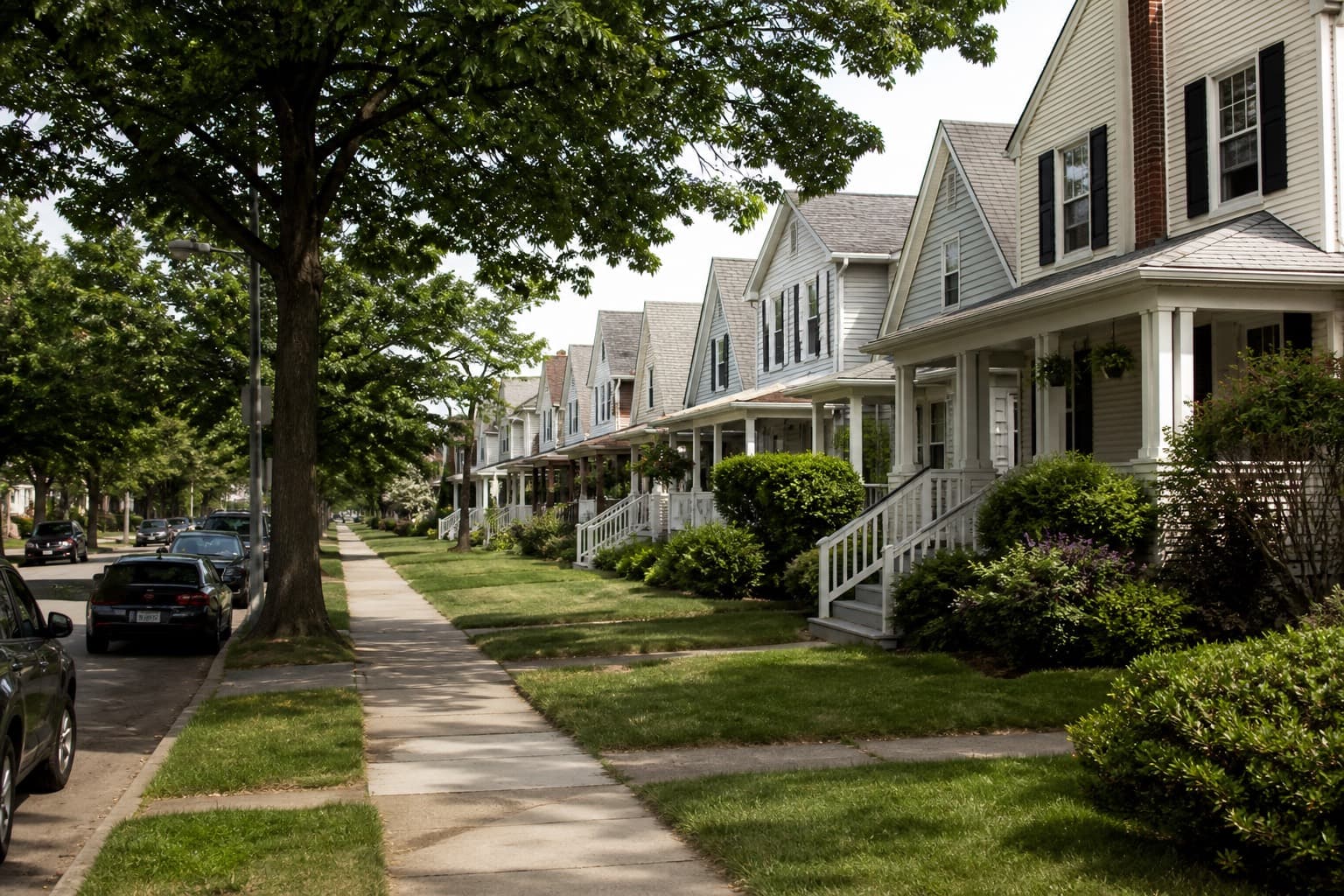
The useful service-area question is not simply mileage. It is whether the route can absorb the travel while meeting service windows, labor requirements, operating costs, and target profit.
This guide shows how to draw a primary area, price the edge, decline cleanly, and take a far stop only when it is a strategy — not a habit. For the day-of board, see route planning and dispatch. For the dollars attached to travel, see how to price lawn care jobs.
Density first, map second
A property the same number of miles away can require very different travel time depending on traffic, road design, and time of day. Use realistic route time and clustering rather than a simple circle.
Ask of every new lead:
- How many existing stops sit within a short hop?
- What day pattern would this join—weekly, biweekly, or one-time work?
- What happens to the route when it rains?
- Does the price recover travel as well as on-site time?
The same service price may work beside several existing stops and fail when the property adds a separate round trip. Include disposal, fueling, and route time in the calculation.
Decision table for new residential leads
| Lead location | Default move |
|---|---|
| Inside dense zone, fills a gap | Standard package pricing |
| Edge of zone, same day pattern | Small premium or standard if it truly shortens the route |
| Meaningful detour from the current sequence | Travel fee, higher service price, waitlist, or decline |
| Opposite side of town, no pocket | Decline or waitlist for a new zone |
| Far, but three other sold stops the same day | Consider — price travel into the day, not one address |
Declining work outside the operating model protects capacity for existing commitments.

Define a service area customers can understand
Use towns, neighborhoods, roads, ZIP codes, or a map to communicate the boundary accurately. Remember that postal areas and straight-line radius may not match practical drive time.
A practical way to draw it:
- Plot last month’s paying stops
- Identify the clusters that form efficient route days
- Define an edge area where work needs individual travel review
- Describe the boundary in terms customers and estimators can apply
- Review it after spring rush and other major route changes
New operators may accept a broad area to build initial demand. Track drive time and collected revenue so the boundary can narrow as recurring clusters develop. See the startup operations checklist.
Example structure (illustrative)
| Zone | Meaning | Pricing |
|---|---|---|
| Core | Existing Tuesday/Thursday pockets | Package rates |
| Edge | Additional travel beyond the core | Disclosed travel fee or higher service price |
| Outside | No cluster | Decline, or project-only at custom price |
| Future cluster | Adjacent area being tested | Standard price or a documented temporary offer |
Put the zone and applicable travel charge on the quote before acceptance. Do not add an undisclosed fee after service.
Trip fees and higher minimums
A travel fee accounts for route time and vehicle cost beyond the standard area.
Common structures include:
- Per visit for recurring work that requires exceptional travel
- Per job for one-time cleanups that you batch
- Higher minimum when a small lot is the problem, not only the miles
- Contract price when a distant commercial site occupies substantial crew capacity
If a route change makes the travel charge unnecessary, document the temporary or permanent adjustment. Pricing exceptions should come from an authorized person rather than an informal promise at the property.
| Situation | Fee logic |
|---|---|
| Recurring weekly outside core | Travel fee or service price that covers every visit |
| First-cut cleanup outside core | Project price + travel; cap how many |
| Vacation one-time | One-time rules + travel |
| Commercial contract | Include travel in the total property price |
Invoices should match the accepted quote. If payment-method pricing is used, verify current disclosure, processor, and legal requirements.
Polite declines that protect the brand
Some suitable customers will still fall outside the current route. Keep the response brief and clear.
A short script:
“Thanks for reaching out. We keep a tight service area so we can stay on time for the neighborhoods we already run. We are not adding stops in [their town] this season. If that changes, we can add you to a waitlist.”
You may offer a referral with permission or say that a group of nearby requests could support a future route review. Do not imply that service is guaranteed.
Do not:
- Apologize with a discount
- Promise “maybe next month” on every far lead
- Accept a below-cost visit without a documented purpose and end date
Website leads should see the service area before submitting a request. Marketplace inquiries still need the same location and profitability review. See marketplace versus owned customer records.
When a distant stop may make sense
Take the long drive when the math or the strategy is real.
Worth it:
- Clustered new zone — enough accepted work to support a practical route block
- High-value commercial with insurance, scope, and a rate that includes travel — commercial vs residential
- Project cleanup priced as a project, not as a mow, and not on the busiest May Tuesday
- Work that improves the route sequence after checking actual travel
- Off-peak capacity you would otherwise idle, still at a floor price
Not worth it:
- A recurring price that does not cover the added travel and service cost
- A lead that only exists on a bidding app and disappears if you leave the app
- A “family friend” rate that becomes the neighborhood rate
- An isolated biweekly stop that requires a separate trip every other week
Recurring plans create an ongoing capacity commitment. Review location and route fit before acceptance rather than relying on a later price change or cancellation.
Expand one adjacent area at a time
Expansion is a project. Treat it like one.
- Pick one adjacent pocket (a subdivision, not a county)
- Set a target based on route hours, drive time, revenue, and capacity
- Use normal pricing or a documented temporary offer that remains above the cost floor
- Assign a day pattern and keep it
- Review travel time and account performance after a defined pilot
- If the cluster does not develop, stop accepting isolated additions and revise the area
Marketing should match the service map. Target the adjacent area the business intends to fill rather than advertising broadly to locations it cannot serve.
When adding a crew, use crew scheduling and day-of dispatch to evaluate route distribution. If using employee location data, provide required notice, limit access and retention, and confirm applicable privacy and employment rules. See scaling from solo to a crew.
Weather, make-ups, and the far stop
Weather reschedules make the cost of a wide service area more visible. A dense neighborhood can often move as a group, while isolated properties require separate travel.
Policy that helps:
- State how edge and outside jobs are prioritized
- Do not displace contracted recurring work without applying the agreed policy
- Give outside-area customers an accurate service window
- Trip fees still apply on the make-up day
If a customer requests a dedicated post-weather trip, check capacity and quote it separately when appropriate.
Put radius in the CRM, not in your head
Each property can carry a zone tag such as Core, Edge, or Outside. Make it visible to authorized estimators and dispatchers in the CRM.
Property notes can store necessary access information and the applicable zone policy. Scheduling software should show route sequence as well as addresses.
Review collected revenue, direct cost, labor time, travel, and service quality by zone. If edge work consistently misses its target, revise the price, schedule, or boundary.
In MowProHQ
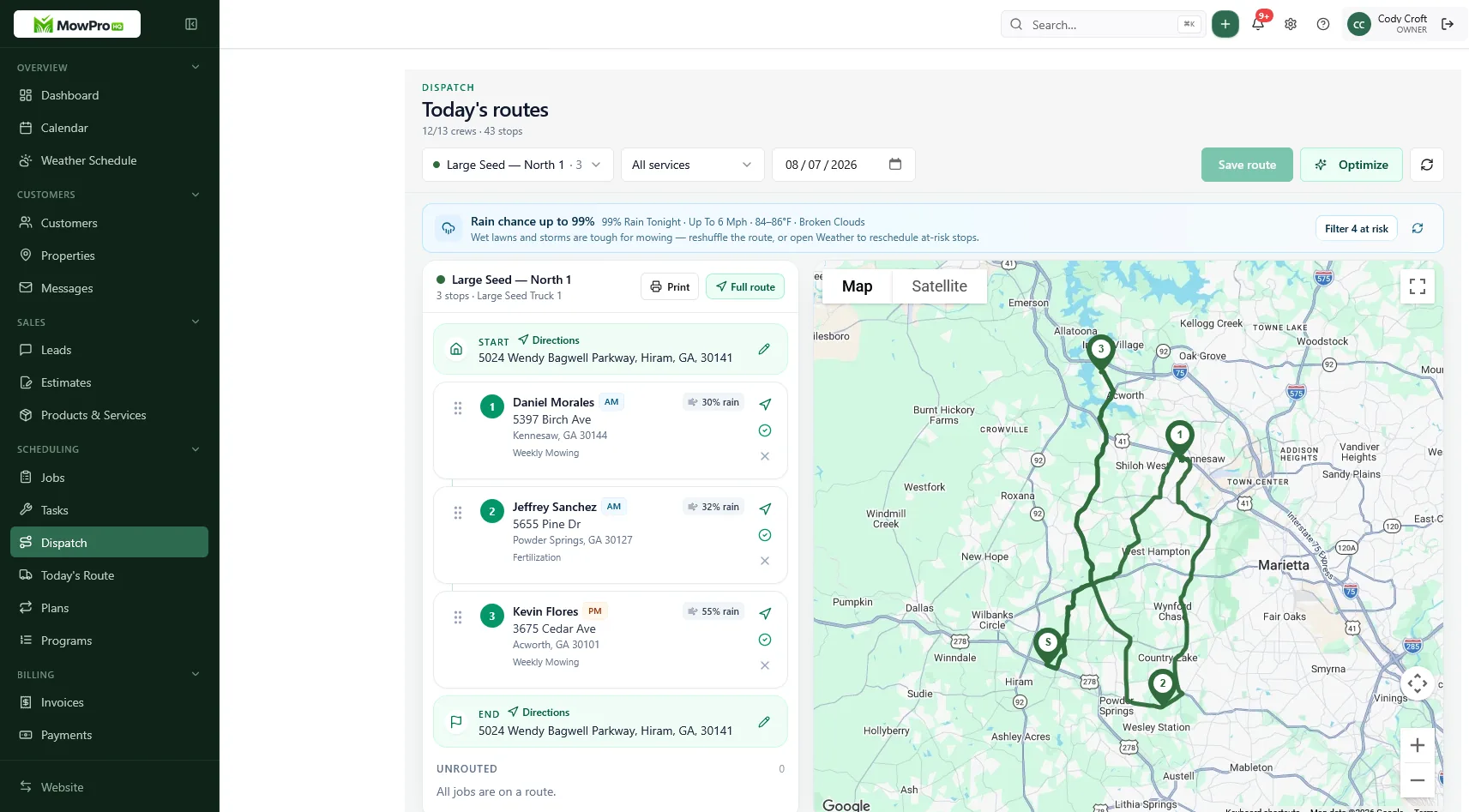
Manage service areas in MowProHQ
MowProHQ connects customers, properties, schedules, quotes, and invoices so estimators and dispatchers can evaluate an address in the context of the current route.
Review current plans and pricing, then create an account and test zone tags, route sequencing, travel lines, and out-of-area lead handling.
Frequently asked questions
- How far should a lawn mowing service drive for a job?
- There is no universal distance. Measure added drive time, labor, vehicle cost, schedule risk, job value, and nearby work. Define a core area, price exceptional travel in advance, and decline or waitlist stops that do not meet the required return.
- What is a good service-area radius for lawn care?
- Use normal travel time and existing customer clusters rather than a fixed mileage rule. Roads, traffic, bridges, equipment, crew costs, and service frequency can make properties at the same distance very different to serve.
- Should I charge a trip fee for lawns outside my area?
- You may use a disclosed travel fee or a higher service price when added travel is outside the standard area. Calculate the full cost, show it on the quote before acceptance, and verify any applicable fee-disclosure rules.
- When is a far lawn mowing stop worth it?
- It may make sense when nearby jobs share the travel, the total contract covers the cost and risk, or the company is deliberately building a new route cluster. Evaluate the whole route rather than the address alone.
- How do I turn down a lawn care lead without sounding rude?
- Thank the customer, explain that the address is outside the current service area, and offer a waitlist or an appropriate referral when available. Do not promise a future opening you cannot reasonably predict.
- How does weather change service-area decisions?
- Weather compresses available route time and can make distant rescheduling harder. State service windows and weather priorities in advance, and apply them consistently with the customer agreement.
- Should I expand my mowing radius to grow?
- Expand when demand, staffing, pricing, and route capacity support a new cluster. Pilot one adjacent area, track actual travel and job performance, and revise the boundary if the expected density does not develop.